Student-Generated Questions: How Asking Kids to Write the Exam Reveals What They Truly Know
Key Takeaways
- Student-Generated Questions (SGQ) is a high-rigor formative assessment strategy where students author their own exam questions and answer keys.
- The complexity of the question a student creates directly mirrors their depth of bloom's taxonomy mastery—from basic recall to evaluation.
- Writing a plausible wrong answer (distractor) in multiple-choice formats forces students to analyze common misconceptions.
- Reviewing student questions takes under five minutes and provides a ready-made item bank for upcoming quizzes and exams.
- The routine shifts students from passive test-takers to active assessors, building metacognition and test-taking confidence.
You hand out Friday's quiz. Five minutes in, a student raises their hand, pointing at a classic application question. "Is this a trick question?" they ask, genuine confusion on their face.
You look at the prompt. It isn't a trick question at all—it simply asks them to take a concept they learned on Tuesday and apply it to a new scenario. But because it doesn't look like the exact bulleted definition on slide four, their brains freeze.
Most students spend their entire academic lives on the receiving end of assessment. They practice answering questions, but they rarely practice constructing them. As a result, they learn to look for surface-level pattern recognition instead of deep structural logic. The moment you flip the script and ask them to become the test-maker, the illusion of learning disappears.
The Direct Answer:
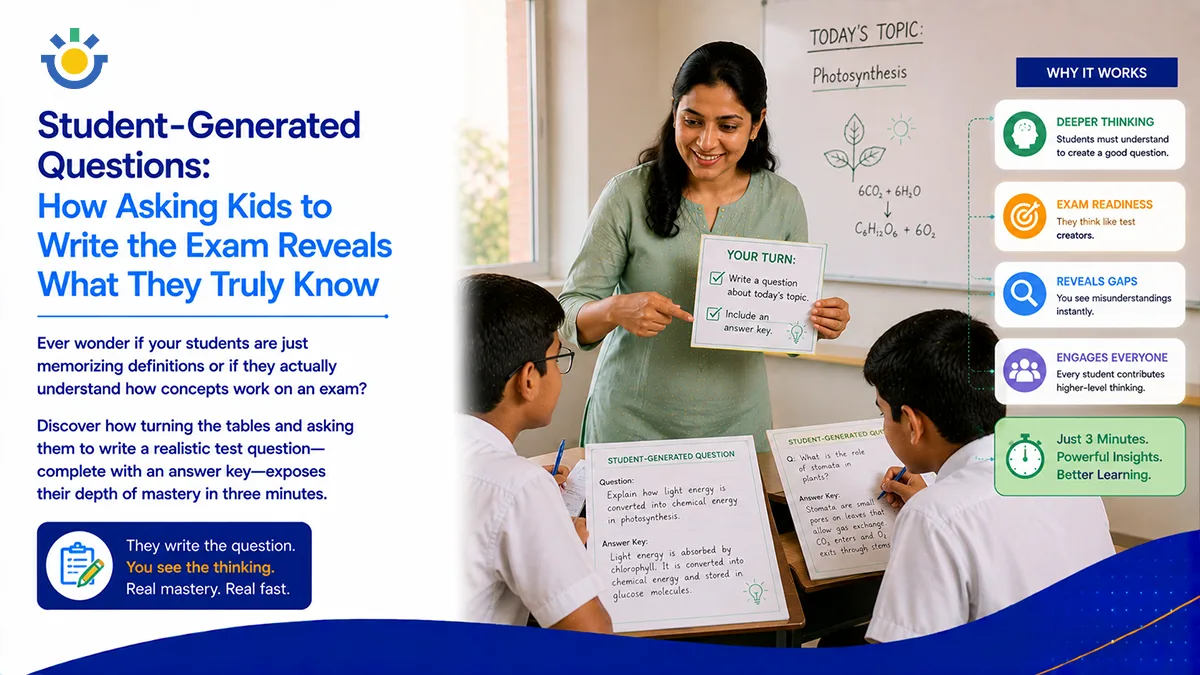
Student-Generated Questions is a formative assessment technique where students write a realistic test question based on the day's lesson, complete with an answer key and explanation. The complexity and structure of their question immediately show whether they are operating at low-level recall or high-level synthesis and evaluation.
The Quick-Scan Parameter:
- Time required: 3–4 minutes for students to write; 3 minutes for teacher review.
- Deliverable: 1 exam-style question + correct answer + brief rationale.
- Differentiating Factor: Distinguishes between surface memorization (recall) and transferrable knowledge (application).
- Primary benefit: Creates a student-driven review bank while diagnosing depth of knowledge.
The Bloom's Taxonomy Flip: Why Writing Questions Beats Answering Them
When a student answers a question you wrote, they are navigating your mental map. They are looking for clues you left behind.
When a student writes the question themselves, they have to construct the mental map from scratch. They must decide: What is the core concept here? What makes an answer correct? And what makes a wrong answer look plausible to someone who wasn't paying attention?
The depth of the question they generate acts as an immediate diagnostic thermometer for their understanding.
How to Execute Student-Generated Questions in 3 Steps
If you simply tell a class to "write a test question," most will give you a basic fill-in-the-blank definition. To get actionable insight, you need clear parameters.
1. Set the Exam Format
Specify the question style based on your learning goals for the day. Multiple-choice and short-scenario questions work best for quick checks.
2. Require the "Answer Key & Rationale"
The real cognitive heavy lifting happens in the answer key. Require students to provide:
- The correct answer.
- A one-sentence explanation of why it's correct.
- (Optional for MCQs) Why the distractor choices are incorrect.
- Weak Question (Recall): "What year did the War of 1812 start?" (Answer: 1812).
- Strong Question (Synthesis): "If the Embargo Act of 1807 had not been passed, how would maritime trade tensions prior to the War of 1812 have been affected?" (Includes scenario + logical rationale).
3. Mine the Cards for Friday's Actual Quiz
Here is the secret to getting 100% student buy-in: tell them you will pick 2–3 of the best student-generated questions to put on the actual upcoming exam.
Instantly, writing questions stops feeling like busywork and starts feeling like an insider advantage.
Scaling Assessment Intelligence Across Your School
Scanning a stack of student-written questions gives an individual teacher an immediate sense of who is ready for advanced work and who is stuck on surface details. But when students across an entire department struggle to move past low-level recall questions, manual paper checks make it hard to spot the trend.
When whole cohorts struggle with analytical thinking, tracking these performance patterns through a centralized dashboard helps instructional leaders adjust curriculum rigor.
By logging these formative checks into a modern Learning Intelligence Operating System (LIOS), school administrators and department heads gain real-time visibility into student Depth of Knowledge (DOK) levels. Teachers can align their questioning techniques, scaffold higher-order thinking, and ensure students are prepared for high-stakes assessments.
- Use index cards: Limit physical space so questions remain concise and focused on a single learning objective.
- Ban simple recall prompts: Explicitly state, "Your question cannot be answered by just looking up a single vocabulary definition."
- Leverage peer testing: Have students swap cards with a partner, answer their peer's question, and verify the answer key.
- Celebrate great distractors: Highlight multiple-choice questions that feature clever, realistic wrong answers based on common misconceptions.
- Build a class question bank: Save high-quality student questions in a digital document for end-of-unit review games.
Conclusion
If you want to know how well a student understands a concept, don't just give them a test—ask them to build one.
By implementing Student-Generated Questions, you transform your class from passive test-takers into active assessors who understand not just what they are learning, but how their knowledge is measured.
Formative Assessment Strategy Matrix
| Strategy | Completion Time | Primary Output | Cognitive Rigor |
| Student-Generated Questions | 3–4 Minutes | 1 Test Question + Answer Key | High (Evaluation & Creation) |
| One-Sentence Summary | 2 Minutes | 1 Compressed Structural Sentence | High (Synthesis & Precision) |
| 3-2-1 Exit Ticket | 3–4 Minutes | 3 Learnings, 2 Facts, 1 Question | Medium (Recall & Reflection) |
| The Muddiest Point | 2 Minutes | 1 Specific Confusion Point | Low-Medium (Self-Diagnosis) |
Frequently Asked Questions
How can teachers track student progress without spending hours on spreadsheets?
What makes Student-Generated Questions different from a standard exit ticket?
How do instructional coaches identify learning trends across an entire department?
How do you help students who only write basic recall questions?
How does surfacing daily student confusion improve long-term test performance?
Can Student-Generated Questions be collected digitally?
Elevate Classroom Rigor and Insight Today
Discover how simple student-driven routines and real-time pulse checks can transform learning outcomes across your entire school.
See How It Works