The One-Sentence Summary: How Extreme Compression Reveals True Student Mastery
Key Takeaways
- The "One-Sentence Summary" is a high-yield synthesis strategy that challenges students to condense a complex topic into a single, grammatically correct sentence.
- It forces deep cognitive processing by requiring students to answer seven core questions: Who/What, Did What, To Whom/What, How, When, Where, and Why?
- It eliminates fluff, memorization shortcuts, and passive regurgitation by testing true conceptual mastery through compression.
- Teachers can scan a stack of 30 one-sentence summaries in under three minutes to assess class-wide understanding.
- The technique develops critical literacy and higher-order thinking across all subject areas, from STEM to humanities.
"In your own words, summarize today's lesson."
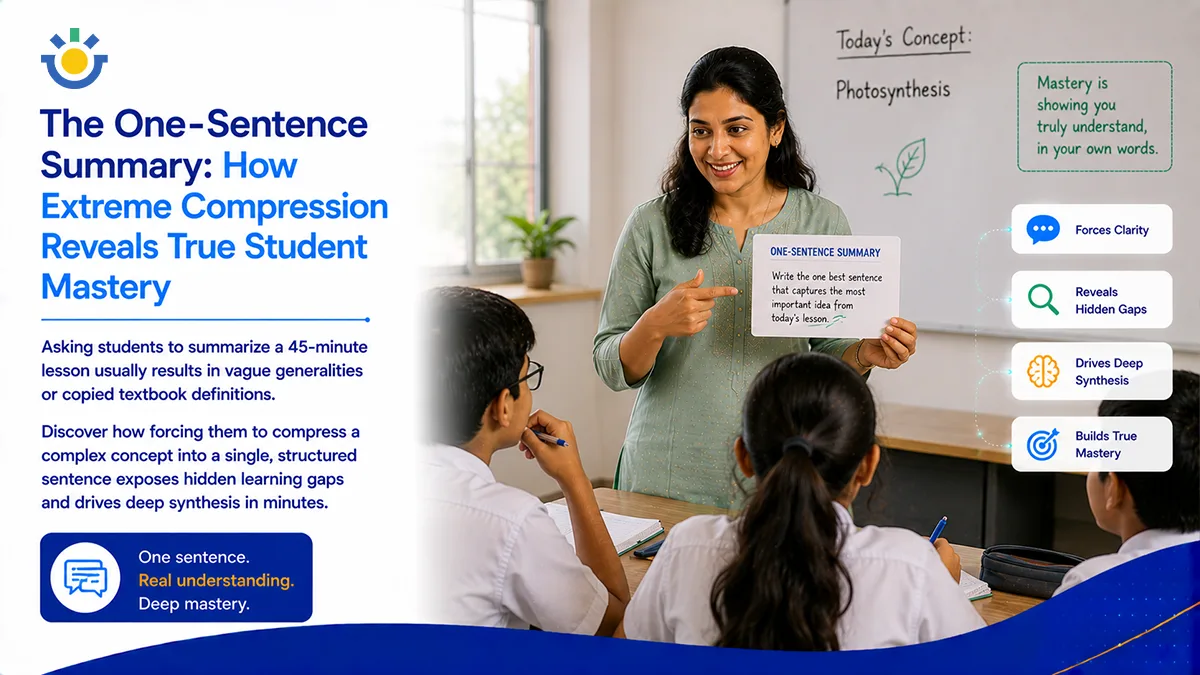
You hand out the exit slips, expecting thoughtful reflections on the complex economic policy you just spent forty minutes breaking down. Five minutes later, you collect the papers. Half the class wrote vague fluff like, "Today we learned about inflation and how prices go up." Three students copied the bolded definition straight off page 114. Two wrote an entire paragraph that managed to say absolutely nothing.
It’s a classic classroom illusion. Students confuse recognition with mastery. They can repeat the vocabulary, but when forced to explain how the moving parts actually fit together, the logic breaks down.
If a student truly understands a concept, they don't need three paragraphs to explain it. They can compress it.
The Direct Answer:
The One-Sentence Summary is a powerful formative assessment tool that requires students to synthesize a complete lesson or reading into one well-crafted sentence. By answering up to seven specific parameters—Who/What, Did What, To Whom, How, When, Where, and Why—students demonstrate precise, high-level understanding rather than surface-level memorization.
The Quick-Scan Parameter:
- Time required: 2–3 minutes at the end of class.
- The Core Constraint: Exactly one grammatical sentence (no run-ons).
- The 7 Parameters: Who/What, Action, Recipient, Method, Time, Place, Cause.
- Primary benefit: Instantly separates superficial recall from deep conceptual understanding.
The Science of Synthesizing: Why Less is More
When you give students unlimited space to write, they hide behind fluff. They throw in buzzwords, pad their sentences, and hope something sticks.
The One-Sentence Summary strips away that safety net. It creates intentional cognitive constraint. To fit an entire historical event, scientific process, or mathematical theorem into a single sentence, a student must evaluate every detail, discard the non-essential facts, and map out the exact cause-and-effect relationship.
This isn't just a writing exercise; it's a rigorous test of metacognition. If a student gets stuck mid-sentence, it’s not a writing block—it’s a learning block.
The WDWWHWW Framework
To keep this strategy from becoming an overwhelming grammar test, give students a clear structural framework. Have them map out the core components before assembling their sentence:
The 7 Essential Parameters
- Who / What? (The main subject or agent)
- Did / Does What? (The core action or process)
- To Whom / What? ( The target or recipient)
- How? (The mechanism or process used)
- When? (The timeline, conditions, or trigger)
- Where? (The context, environment, or location)
- Why? (The ultimate cause, purpose, or outcome)
Example in Action (Biology)
- Weak Summary: "Enzymes break down stuff in the body so we can digest food faster."
- One-Sentence Summary: "During digestion (WHEN), specialized enzymes (WHO/WHAT) accelerate chemical breakdown (DID WHAT) of complex nutrients (TO WHAT) in the small intestine (WHERE) by binding to specific substrates (HOW) to lower the activation energy required for absorption (WHY)."
Notice the difference? The second sentence proves total comprehension of the entire biological mechanism.
How to Execute the One-Sentence Summary Routine
1. Set the Constraint
Announce that students have two minutes to write one single, complete sentence. Explicitly warn against run-on sentences joined by endless conjunctions.
2. Scaffold with a Matrix
For beginners, display a simple matrix on the board where they can jot down words for Who, What, How, and Why before combining them.
3. Fast Scan for Feeder Gaps
As you collect the slips, group them into three rapid buckets:
- Complete Synthesis: Clear subject, action, mechanism, and purpose.
- Mechanism Missing: Got the What, but missed the How or Why.
- Logical Breakdowns: Inaccurate cause-and-effect connections.
Use the middle and bottom piles to shape the opening five minutes of tomorrow's class.
Scaling Synthesis Across Your Entire Curriculum
A stack of index cards showing sharp student synthesis is a teacher's dream. But when school leaders want to evaluate whether students are developing deep analytical skills across all departments, tracking these gains manually is nearly impossible.
Connecting these daily formative checks into a centralized dashboard provides real-time visibility into cross-curricular performance.
By leveraging a modern Learning Intelligence Operating System (LIOS), instructional coaches and department heads can see where students excel at high-level synthesis and where writing-to-learn strategies need reinforcing—ensuring academic rigor is aligned from English to Earth Science.
- Enforce the "One Sentence" rule strictly: If a student uses a period and starts a second sentence, send it back for revision.
- Adapt parameters to the subject: Humanities may focus more on Who/When/Why, while STEM subjects may emphasize What/How/Why.
- Display a model on the board: Show students the difference between a vague sentence and a highly synthesized one before they start.
- Peer-edit for constraints: Have students swap papers with a partner to check if all designated parameters are present in a single sentence.
- Use it as a pre-writing tool: Use this routine as the first step before students outline longer essays or lab reports.
Conclusion
True understanding isn't about how much a student can write—it's about how effectively they can strip away the noise and capture the core truth of a concept.
By making the One-Sentence Summary a regular habit in your classroom, you teach students to stop hiding behind fluff, master the art of synthesis, and prove what they actually know.
Formative Assessment Strategy Matrix
| Strategy | Completion Time | Primary Focus | Best Used For |
| One-Sentence Summary | 2–3 Minutes | Extreme Compression & Synthesis | End-of-lesson checks & essay thesis building |
| The Minute Paper | 1 Minute | Main Takeaway + Unanswered Question | General lesson check-ins & warm-up planning |
| The Muddiest Point | 2 Minutes | Isolating Specific Misconceptions | Target re-teaching before moving forward |
| 3-2-1 Exit Slip | 5 Minutes | Multi-Layered Recall & Reflection | End-of-unit or weekly review synthesis |
Frequently Asked Questions
How can teachers track student progress without spending hours on spreadsheets?
How do you keep students from just writing giant run-on sentences?
How do instructional coaches identify learning trends across an entire department?
Can the One-Sentence Summary work in quantitative subjects like Math?
How does surfacing daily student confusion improve long-term test performance?
What is the best way to collect One-Sentence Summaries digitally?
Ready to Elevate Student Thinking Across Your School?
Discover how simple synthesis routines and real-time pulse checks can transform learning outcomes across your entire school without adding hours to teacher workloads.
See How It Works