The Minute Paper: How One Minute at the End of Class Can Fix Your Entire Lesson Plan
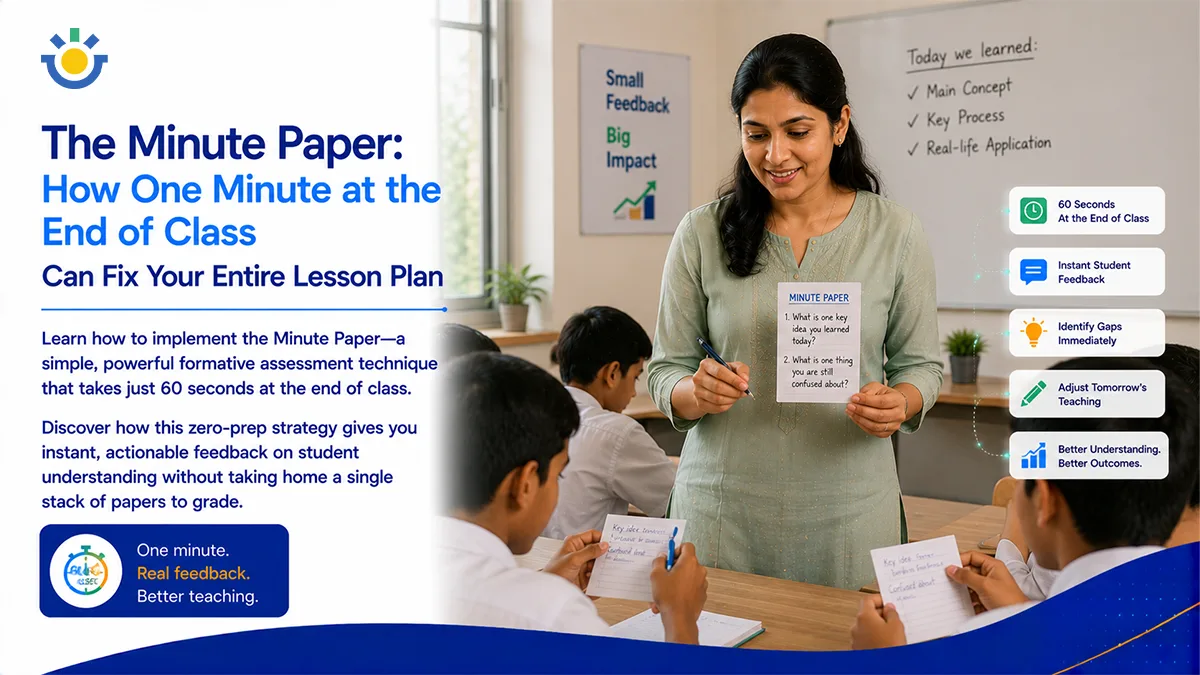
Key Takeaways
- The Minute Paper is a zero-prep formative assessment tool that takes 60 seconds at the end of class to measure core objective retention.
- Forcing immediate recall strengthens student memory pathways and instantly reveals whether a lesson's key takeaway actually landed.
- Teachers can scan a stack of Minute Papers in under two minutes, eliminating the need for late-night grading.
- Aggregating Minute Paper data into a central system helps school leaders track real-time instructional impact across classrooms.
The bell is about to ring in three minutes. You have just wrapped up what felt like a masterclass of a lesson. The slides were crisp, the examples were clear, and nobody asked a single question when you paused and asked, "Does everyone understand?" You pack up your bag, feeling like you nailed it.
Then Friday’s quiz papers hit your desk.
As you flip through the responses, that familiar, sinking feeling returns. A third of the class completely missed the primary takeaway. They remembered the fun illustration on slide four, but the core formula? Completely lost. You realize that for the past three days, you have been building complex new concepts on top of a foundation that was never actually there.
The Direct Answer:
The Minute Paper is a rapid, formative assessment technique where students spend the final 60 seconds of class writing down the single most important thing they learned that day. It forces active memory retrieval for students while providing teachers with immediate, zero-grading data on whether their core learning objective landed.
Execution Time: 60 seconds at the end of a lesson.
Prep Required: Zero (requires only paper scraps, index cards, or a simple digital form).
Primary Benefit: Instant diagnostic feedback with zero nighttime grading.
System Integration: Insights can be fed directly into learning analytics workflows to monitor daily comprehension trends across departments.
The Illusion of Understanding (and Why We Fall for It)
When a teacher stands at the front of the room and asks, "Does this make sense?" students almost always nod. They are not trying to deceive you; they genuinely believe they understand in that moment. Watching someone demonstrate a concept feels effortless, creating an illusion of mastery.
The Minute Paper shatters that illusion—gently, quickly, and before it turns into a failing grade on a mid-term exam.
By asking a student to take out a slip of paper and write down the single most critical insight from the last forty minutes, you shift them from passive listeners to active processing. If they cannot put the main idea into words, they didn't fully catch it. And as a teacher, you need to know that today, not three weeks from now.
Anatomy of an Effective Minute Paper Prompt
The beauty of the Minute Paper lies in its radical simplicity. You are not asking for an essay, and you are not giving a pop quiz. You are asking for a single, focused reflection.
While the classic prompt asks for the "most important thing learned today," you can adjust the focus depending on your specific goals for the lesson:
The key is keeping the boundary strict: 60 seconds only. The time constraint is what keeps the exercise low-stakes for students and effortless for you.
How to Read 120 Responses in Under Two Minutes
The biggest fear teachers have with daily assessments is the mountain of paper it creates. But the Minute Paper is explicitly designed to solve this. You are not grading grammar, spelling, or sentence structure—you are spot-checking alignment.
Here is the two-minute scanning method:
- Sort into three quick piles: High-alignment (got the main point), Partial-alignment (got a secondary point), and Missed (off-target).
- Count the ratios: If 80% or more of your responses are in the high-alignment pile, your lesson hit the mark. Move on tomorrow.
- Identify the friction: If the partial or missed piles are larger than 20%, look for common themes. You now have your warm-up review topic for tomorrow morning.
When instructional patterns like this repeat across weeks, logging these trends into a centralized dashboard allows school leaders to identify where additional support or curriculum pacing tweaks might be needed.
Ready to try this in your classroom tomorrow? Follow this simple execution playbook:
- Set the timer: Give students exactly 60 seconds before the final bell rings to keep the activity crisp and focused.
- Keep prompts specific: Ask "What was the single most vital principle of gravity we covered today?" rather than a vague "What did you learn?"
- Use low-tech or zero-friction tech: Index cards, paper scraps, or a simple single-question digital poll all work perfectly.
- Close the loop tomorrow: Start the next morning's class by reading two or three great (and anonymous) student responses to reinforce the learning objective.
Comparison: Minute Paper vs. Traditional Exit Tickets
| Feature | The Minute Paper | Standard Multi-Question Exit Ticket |
| Completion Time | 60 Seconds | 5 to 10 Minutes |
| Cognitive Load | High Synthesis (One Core Idea) | Mixed Recall & Problem Solving |
| Teacher Review Time | 1 to 2 Minutes Total | 15 to 30 Minutes Total |
| Primary Purpose | Immediate Objective Alignment | Detailed Skill & Task Evaluation |
| Prep Required | Zero | Moderate (Question Design Needed) |
Frequently Asked Questions
How can school leaders track lesson objective alignment across grade levels?
What is the primary difference between a Minute Paper and a quiz?
How does the Minute Paper technique reduce nighttime grading for teachers?
What should a teacher do if half the class misses the core point on a Minute Paper?
How can digital tools streamline the Minute Paper process for large classrooms?
Can the Minute Paper be adapted for younger elementary students?
Turn Classroom Micro-Insights Into School-Wide Growth
Small daily checks like the Minute Paper hold the key to understanding student progress.
Find More Techniques Here