Think-Pair-Share: How a 3-Minute Routine Turns Passive Listeners into Active Explainers
Key Takeaways
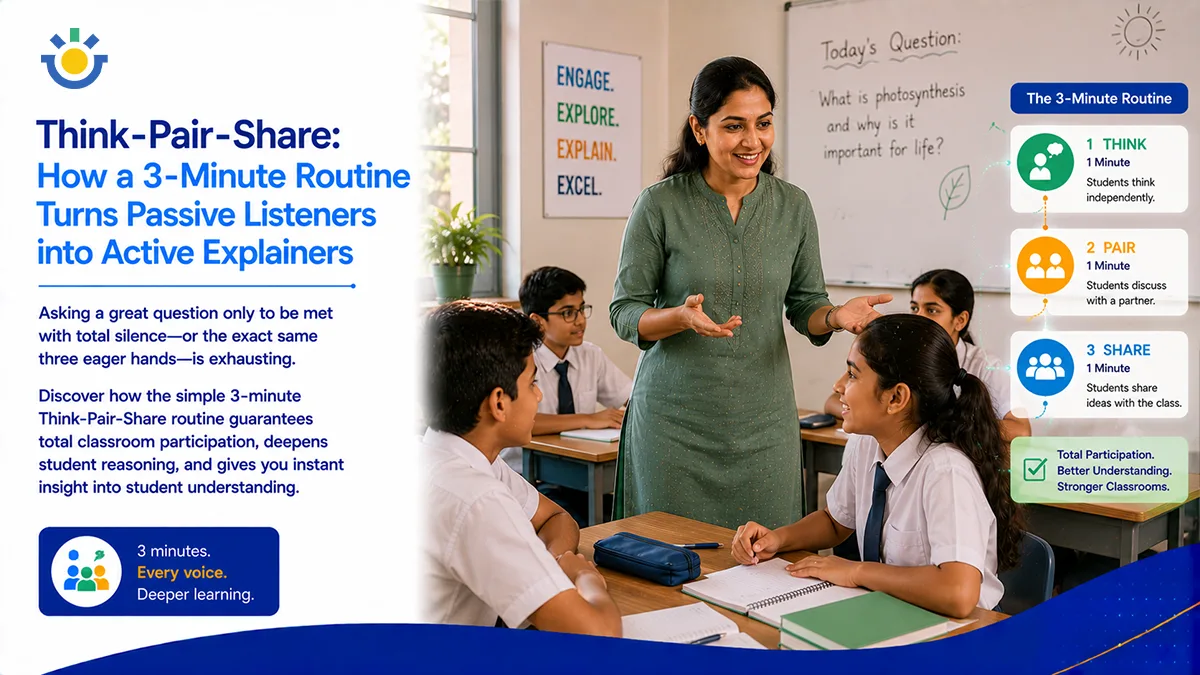
- Think-Pair-Share (TPS) is a three-step collaborative learning strategy designed by Frank Lyman in 1981.
- The structure includes: 60 seconds of silent thinking, 2 minutes of partner discussion, and targeted sharing with the class.
- It eliminates the "same three hands raised" syndrome by forcing 100% active participation and verbal processing.
- Giving students quiet wait time before speaking dramatically increases response quality and builds confidence for hesitant learners.
- The technique serves as an immediate, zero-prep formative assessment tool that teachers can observe in real time.
You ask the class a brilliant, thought-provoking question. You pause, expecting a sea of raised hands. Instead, you get crickets.
Three seconds of awkward silence stretch into ten. Up goes Maya’s hand in the front row, right on cue—the same student who answers every single question. In the back, two kids are staring at the ceiling, another is tracing lines on their desk, and half the class is silently praying you won't call on them.
You take the path of least resistance: you call on Maya, she gives the right answer, you nod, and you move on. But deep down, you know the truth. Maya learned something today. The rest of the room just watched her learn.
The Direct Answer:
Think-Pair-Share is a low-stakes cooperative learning structure where teachers pose a prompt, give students 60 seconds of silent individual think time, pair them up for a 2-minute discussion, and then invite pairs to share their ideas with the room. It shifts the cognitive load from the teacher to every student in the classroom simultaneously.
The Quick-Scan Parameter:
- Step 1 (Think): 60 seconds of silent, uninterrupted reflection.
- Step 2 (Pair): 2 minutes of peer discussion and verbal refining.
- Step 3 (Share): Calling on pairs to share synthesized insights.
- Primary benefit: Drives 100% student engagement while providing immediate formative assessment data.
Why Calling on Single Students Kills Classroom Momentum
When you ask a question and immediately call on one person, 29 other brains instantly shut down. It's human nature. The danger of non-participation disappears, so the need to think vanishes with it.
Traditional whole-class q-and-a sessions create a spectator sport. The Think-Pair-Share routine dismantles this by adding two critical ingredients: wait time and peer safety.
By forcing a mandatory pause before anyone speaks, you give reluctant thinkers the space to assemble their thoughts. And by letting them test those thoughts on a single peer first, you remove the terrifying risk of sounding "wrong" in front of thirty people.
The 3-Step Execution Matrix
Executing Think-Pair-Share effectively isn't about just saying "talk to your neighbor." It requires tight boundaries and intentional framing.
1. Think (60 Seconds)
Pose a prompt that doesn't have a simple yes-or-no answer. Then, enforce absolute silence for one full minute.
"I want everyone's pen down and eyes up here. For the next 60 seconds, no talking. I want you to decide which variable caused the reaction and why."
2. Pair (2 Minutes)
Turn to assigned partners. The goal isn't just to repeat an answer, but to compare logic and refine the idea together.
As students converse, walk the room. Listen in on two or three pairs. You aren't grading—you're collecting diagnostic evidence on how well the concept was processed.
3. Share (1–2 Minutes)
Instead of asking "Who wants to share?", use cold-calling or lower the pressure even further by asking students to share what their partner said:
"Alex, what was a point your partner brought up that surprised you?"
This simple twist rewards active listening and protects sensitive egos.
Scaling Collaborative Insights Across Your School
Observing rich discussions in a single room gives an instructor instant clarity on that period's learning. But when school leaders want to understand if active learning techniques are driving retention across entire grade levels, manual classroom checks aren't enough.
Tracking engagement and comprehension patterns through a centralized dashboard lets instructional coaches see where students consistently hit conceptual hurdles.
By connecting daily formative checks into a modern Learning Intelligence Operating System (LIOS), departments can align their questioning strategies. Administrators can identify which subjects benefit most from peer-led reasoning and adjust professional development to support active learning school-wide.
- Enforce the silence during "Think": Do not let eager students whisper early; processing time is where the deep cognitive work happens.
- Assign designated partners: Pre-assign partner A and partner B to eliminate awkward shuffling or left-out students.
- Ask open-ended questions: Avoid simple recall prompts; use questions that require evaluation, comparison, or justification.
- Eavesdrop strategically: Use pair time to identify strong responses or common misconceptions so you know exactly who to call on during "Share."
- Frame sharing around listening: Frequently ask, "What did your partner explain to you?" to hold students accountable during peer talks.
Conclusion
Transforming your classroom from a room of quiet spectators into a hub of active explainers doesn't require complex lesson plans or expensive tech.
It takes three minutes, a well-crafted prompt, and the structure to let every student think, talk, and own their learning.
Active Learning Strategy Matrix
| Technique | Completion Time | Cognitive Focus | Primary Benefit |
| Think-Pair-Share | 3 Minutes | Processing & Peer Refinement | Ensures 100% participation & builds verbal confidence |
| Turn and Talk | 1 Minute | Quick Retrieval & Verification | Fast energy reset during lengthy instruction |
| Peer Instruction | 5 Minutes | Concept Testing & Argumentation | Forces students to defend reasoning with evidence |
| Jigsaw Method | 15–20 Minutes | Deep Mastery & Teaching Peers | Fosters interdependent learning across complex topics |
Frequently Asked Questions
How can teachers track student progress without spending hours on spreadsheets?
What is the difference between Think-Pair-Share and a standard Turn and Talk?
How do instructional coaches identify learning trends across an entire department?
How do you keep noisy classrooms focused during the "Pair" phase?
How does surfacing daily student confusion improve long-term test performance?
Can Think-Pair-Share be adapted for digital or hybrid learning environments?
Ready to Turn Classroom Silence into Active Engagement?
Discover how simple collaborative routines and real-time pulse checks can transform learning outcomes across your entire school.
See How It Works