10 Fast Classroom Assessment Techniques That Actually Work
Key Takeaways
- Classroom Assessment Techniques (CATs) are low-stakes, ungraded formative feedback tools used in real-time.
- CATs like the Minute Paper and Muddiest Point help identify learning gaps before high-stakes exams.
- Integrating 2–3 minute feedback loops improves student retention and reduces teacher grading overload.
- Modern analytics tools help aggregate CAT data into actionable classroom insights effortlessly.
It’s 10 minutes before the bell. You’ve just finished explaining a complex core concept. You pause, scan the room, and ask the age-old question: "Does everyone understand?" A few nod automatically. Most stare back with blank, tired eyes. You assume no news is good news, wrap up class, and grade the midterms three weeks later—only to discover half the class completely missed the main point. That sinking feeling isn't a failure of your teaching; it's a failure of the feedback loop. When we rely on delayed end-of-unit tests to measure comprehension, we find out where students fell off the track long after the train has left the station.
The Direct Answer:
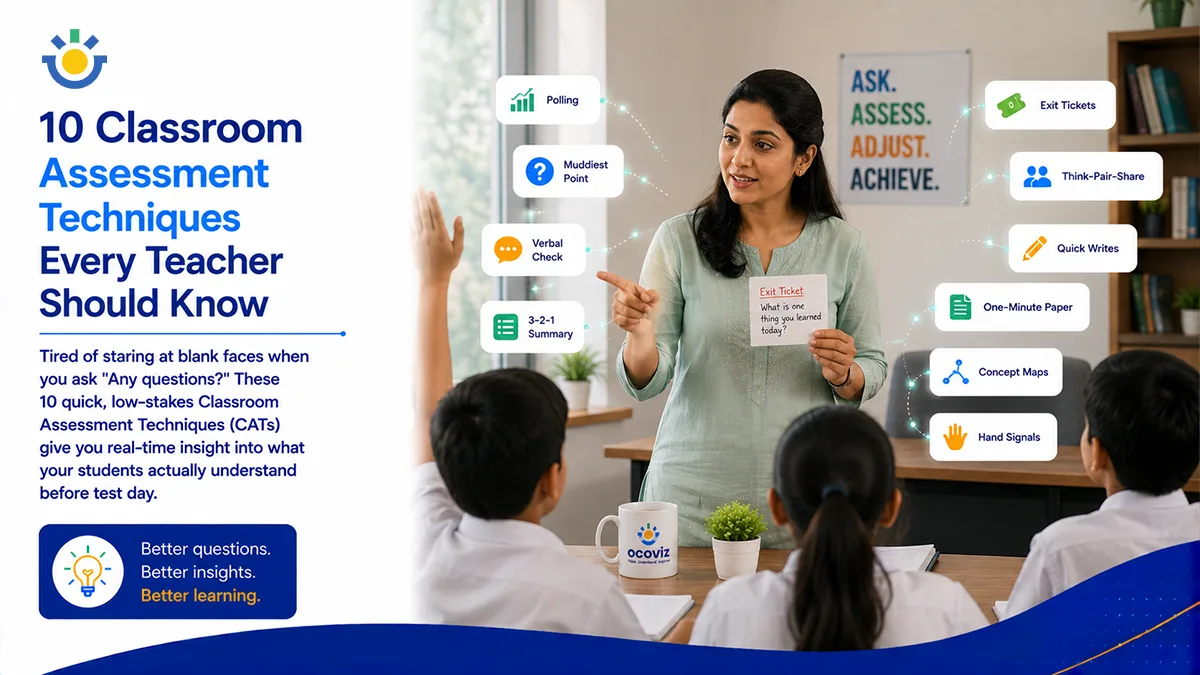
Classroom Assessment Techniques (CATs) are rapid, ungraded, in-class activities designed to give teachers instant feedback on student learning during the lesson. Rather than evaluating students for a grade, CATs allow educators to adjust their teaching mid-course to address misconceptions immediately.
The Quick-Scan Parameter:
- Primary Goal: Real-time formative feedback, zero grading burden.
- Average Time Required: 1 to 5 minutes per technique.
- Top Techniques: Minute Paper, Muddiest Point, Think-Pair-Share, 3-2-1 Exit Ticket.
- Key Impact: Increases student recall, boosts engagement, and eliminates post-test surprises.
Why Traditional Testing Leaves Teachers in the Dark
For decades, the standard loop in education has been simple: teach for three weeks, give a quiz, grade it on Sunday night, and move on to the next chapter.
The problem with this approach is timing. A summative test acts like an autopsy—it tells you what died, but it’s too late to save the patient.
By contrast, formative tools act like a pulse check. They take two minutes, require zero red pen marks, and tell you precisely who is breathing and who is suffocating under new concepts.
TRADITIONAL FEEDBACK LOOP: Teach 3 Weeks > High-Stakes Test > Grade & Move On > Too late to pivot.
CATs FEEDBACK LOOP: Teach Concept > 2-Min CAT Check > Pivot Next Lesson > Real-time adjustment.
10 Quick Classroom Assessment Techniques You Can Use Tomorrow
Here are 10 battlefield-tested assessment techniques that require almost zero prep time and zero extra night-time grading.
1. The Minute Paper
At the end of a lesson, ask students to write down the single most important thing they learned today on an index card or digital form. It forces immediate recall and reveals if your core objective actually landed. Check How
2. The Muddiest Point
Ask one simple question: "What was the most confusing point in today’s lesson?" Scanning these for two minutes after class tells you exactly what to re-explain tomorrow morning before moving forward. Check How
3. Think-Pair-Share
Pose a thought-provoking prompt. Give students 60 seconds to think alone, two minutes to discuss with a partner, and then call on pairs to share. It transforms passive listeners into active explainers. Check How
4. The One-Sentence Summary
Challenge students to synthesize a complex concept into a single, grammatical sentence that answers Who did/does What to Whom, How, When, Where, and Why? If they truly understand it, they can compress it. Check How
5. Concept Mapping
Have students sketch a quick visual diagram connecting 4–5 key terms from the week's lessons using arrows and short linking words. It exposes instantly whether they see the big picture or just isolated facts. Check How
6. The 3-2-1 Exit Ticket
Before leaving the room, students hand you a card with:
- 3 things they learned today
- 2 interesting facts or connections
- 1 unresolved question they still have Check How
7. Student-Generated Questions
Ask students to write one realistic exam question based on today's material, complete with an answer key. The depth of their question will reveal the depth of their comprehension. Check How
8. Memory Matrix
Hand out a simple 2x2 or 3x3 grid with row and column headers, leaving the inner cells blank. Students quickly fill in key facts, dates, or formulas to test their categorization skills. Check How
9. Application Cards
After teaching a theory or principle, ask students to write down one real-world application of that principle on an index card. This checks whether they can transfer classroom knowledge to practical situations. Check How
10. Misconception Check
Present a common false assumption, a flawed formula, or a deliberate mistake on the board. Ask students to spot the error and write two sentences explaining why it's incorrect. Check How
Turning Classroom Noise Into Actionable Insights
Collecting feedback slips is the easy part. The real challenge is knowing what to do with 150 index cards sitting on your desk at 3:00 PM.
If you spend two hours sorting paper responses every afternoon, you've simply replaced one grading headache with another.
This is where smart digital tracking transforms the process. Rather than letting formative data pile up on paper, modern educators use a centralized dashboard to track real-time learning signals over time. When student feedback is logged digitally, trends jump out immediately.
When you can easily review visual student progress trends across weeks of quick checks, you stop relying on intuition and start making surgical teaching adjustments.
How to Implement CATs Without Overwhelming Yourself
- Start with just one technique: Pick either the Minute Paper or Muddiest Point and run it twice this week.
- Always close the loop: Spend the first two minutes of the next class addressing the top 2–3 sticky points discovered in yesterday's assessment.
- Keep it strictly low-stakes: Remind students that these quick checks are not graded for accuracy—they are tools to help you teach them better.
- Rotate your methods: Swap between individual writing, peer discussions, and visual mapping so different learning styles can shine.
- Aggregate your data digitally: Log trends into a Learning Intelligence Operating System (LIOS) to track long-term learning growth across your entire department.
Teaching isn't about covering material; it's about making sure the material is actually received. By weaving simple, two-minute checks into your daily routine, you trade late-night grading stress for true classroom connection.
Comparison Matrix: Finding the Right Assessment Technique for Your Lesson
| Technique | Time Needed | Primary Measurement Focus | Preparation Required | Ideal Lesson Phase |
| Minute Paper | 1–2 Minutes | Core synthesis & main takeaways | Minimal (Prompt on board) | End of class |
| Muddiest Point | 1–2 Minutes | Specific points of confusion | None | Mid-lesson or End |
| Think-Pair-Share | 3–5 Minutes | Engagement & peer reasoning | Low (1 Discussion prompt) | Mid-lesson |
| Concept Mapping | 5–10 Minutes | Relational logic & big-picture connections | Low (Key term list) | Unit synthesis |
| 3-2-1 Exit Ticket | 3–5 Minutes | Balanced reflection & remaining gaps | Minimal (Blank index cards) | Lesson closure |
| Misconception Check | 3–5 Minutes | Critical thinking & error analysis | Medium (Crafted mistake) | Lesson opening / Warm-up |
Frequently Asked Questions
How can teachers track formative assessment results without adding hours of extra grading?
What is the fastest classroom assessment technique for a 45-minute lesson?
How do Classroom Assessment Techniques improve student retention before major exams?
Can CATs be adapted for hybrid or fully online classrooms?
How often should a teacher use formative assessment techniques in class?
What is the difference between a CAT and a traditional quiz?
Stop Flying Blind in the Classroom
Turn daily student checks into actionable learning intelligence with Ocoviz.
🚀 Book a Free Demo