Study Smarter, Not Longer: 4 Science-Backed Hacks to Ace Your Exams in Half the Time
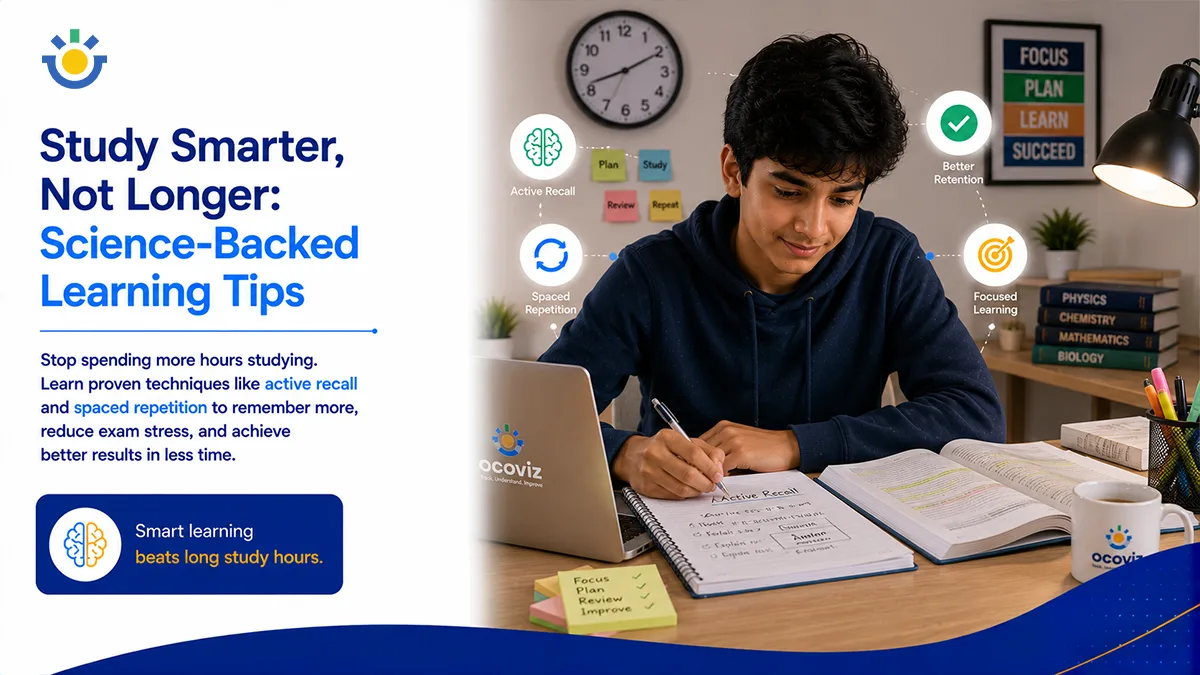
Key Takeaways
- Passive re-reading and highlighting create a false sense of competence; active recall builds lasting memory traces.
- Spaced repetition leverages the brain's forgetting curve to lock concepts into long-term memory with less total study time.
- Interleaving—mixing up related topics within a single session—sharpens problem-solving and diagnostic skills.
- Ocoviz acts as a 24/7 Socratic study co-pilot, guiding students through tough doubts using step-by-step hints instead of direct answers.
- Studying in focused 25–45 minute blocks with complete distraction-free intensity yields far higher retention than marathon cramming sessions.
It is 11:30 PM on a Sunday. You are sitting at your desk, surrounded by empty coffee cups, sticky notes, and a pastel mountain of highlighter ink. You’ve read Chapter 4 three times now. Your eyes are dry, your shoulders are tight, and you tell yourself: "If I just sit here for two more hours, it will stick."
Here is the brutal truth that cognitive scientists have known for decades: re-reading notes feels like studying, but it is actually an illusion.
When you run a neon marker over a printed page, your brain recognizes the text. It whispers, "Ah yes, I know this." But recognizing a fact when it's staring you in the face is entirely different from retrieving that same fact from your own memory during a timed exam.
You don't need more hours at your desk. You don't need more highlighters. You need study methods that work with your brain's neurobiology instead of grinding against it.
The Direct Answer:
Studying smarter means using evidence-based cognitive strategies—primarily active recall, spaced repetition, and interleaving—to force the brain to actively retrieve and organize information. This strengthens neural pathways far more effectively than passive re-reading or marathon cramming.
The Quick-Scan Parameter:
- Highest Efficiency Method: Active Recall (testing yourself without looking at notes).
- Best Retention Schedule: Spaced Repetition (reviewing material right as memory begins to decay).
- Problem-Solving Booster: Interleaving (mixing different problem types in one session).
- AI Co-Pilot Advantage: Socratic hint-driven doubt solving that keeps you in the driver's seat.
Why Is Passive Re-Reading Wasteful?
When you passively re-read a page or watch a video explanation for the third time, your brain operates on autopilot. It feels easy, which tricks you into thinking you are learning deeply.
Cognitive psychologists call this the Illusion of Competence. Real learning requires friction. When your brain has to struggle slightly to recall a formula or construct an explanation from scratch, it fires specific neural circuits that signal to your brain: "This information matters—store it."
PASSIVE STUDY LOOP: Read Chapter > Highlighting > False Confidence
ACTIVE RECALL LOOP: Close Book > Quiz Yourself > Strong Memory Trace
How Does Spaced Repetition Beat Marathon Cramming?
In 1885, psychologist Hermann Ebbinghaus discovered the Forgetting Curve: without review, humans forget nearly 70% of new information within 24 hours.
THE SPRA-EFFECT ON RETENTION
| Study Strategy | Retention |
| 1 Session x 5 Hours (Night before exam) | ~20% |
| 5 Sessions x 30 Mins (Spaced over 10 days) | ~80% |
Cramming five hours the night before a test forces information into short-term working memory. You might survive tomorrow's quiz, but two weeks later, the knowledge is completely gone.
Spacing out short 30-minute review sessions across several days resets the forgetting curve each time. Every time you pull that memory back just before it fades, you double its lifespan in your long-term storage.
Why does mixing it up make you a better problem solver?
When you take a test, the questions don't have titles at the top telling you the answers, like: "Hey! Use Rule #3 for this question!"
You have to look at the problem and figure out two things:
- "What kind of problem is this?" (Diagnosing)
- "How do I solve it?" (Executing)
When you practice mixing different types of questions during study time, your brain gets super fast at figuring out which tool to pull out of your toolbox before you start working. It feels a little harder while you're doing it, but it builds real skill that sticks!
How Can Socratic Doubt-Solving Fix Stuck Moments Faster?
Getting stuck on a tough physics step or a tricky algebra proof at 9:00 PM usually kills your momentum. You either waste an hour staring at the page or jump online to find a pre-packaged answer.
Copying a direct solution creates the same illusion of competence as re-reading. Ocoviz bridges this gap with Socratic guidance.
"True comprehension isn't built when someone gives you the answer—it happens in the micro-second when you figure out the next step yourself." — State of Learning Intelligence Report
When you hit a wall, the integrated 24/7 Socratic AI Co-Pilot for step-by-step doubt solving doesn't just blurt out the final answer. It asks targeted scaffolding questions, highlights forgotten rules, and lets you cross the finish line.
Practical Takeaways for Students
- Ditch the highlighters: Replace passive highlighting with self-quizzing using flashcards or practice test prompts.
- Apply the Blurting Method: Read a topic once, close the book, write down everything you can remember on a blank page, then check what you missed.
- Use the 30-Minute Rule: Study intensely for 30 minutes, rest for 5, and review a different subject or problem type.
- Log your weak spots immediately: Track where your logic breaks so your study tools can target your specific conceptual gaps.
Conclusion
Studying hard is commendable, but studying smart is what wins. You don't need to sacrifice your sleep, your hobbies, or your sanity to earn great marks.
By replacing passive habits with active recall, spaced repetition, and smart doubt-solving, you can learn deeper, retain longer, and regain control of your time.
The Comparison Block: Passive vs. Science-Backed Study Methods
| Feature / Metric | Passive Re-Reading | Active Recall & Spaced Repetition |
| Primary Mechanism | Visual recognition | Neural retrieval & memory reconstruction |
| Long-Term Retention | Very low (~10-20% after a week) | High (~70-80% sustained retention) |
| Effort Level | Low mental strain (feels easy) | High initial effort (desirable difficulty) |
| Exam Adaptability | Struggles with rephrased prompts | Excels at application-based questions |
Frequently Asked Questions
Why is active recall better than re-reading notes for exam preparation?
How many hours a day should a student study to get top marks?
What is the spaced repetition technique and how do I start using it?
How can a Learning Intelligence system help me study more efficiently?
What should I do when I get stuck on a homework problem late at night?
What is the difference between block studying and interleaving?
Ready to Work Smarter and Cut Your Study Time in Half?
Stop copying answers and start mastering concepts with a study co-pilot built to help you think, learn, and excel.
Try the 24/7 Smart AI Tutor