Entab, Fedena, and Teachmint Got 15 Years of School ERP Right. Here’s the One Thing None of Them Do.
Key Takeaways
- Legacy Indian school ERPs (Entab, Fedena, Teachmint, MyClassboard, Vidyalaya) excel at operational record-keeping—fee receipts, attendance logs, timetables, and circulars—but operate purely on historical data.
- A traditional ERP records when a student’s marks drop or attendance falls, but lacks predictive capability to flag academic risk before exams occur.
- A Learning Intelligence Operating System (LIOS) sits on top of or replaces transactional ERPs by correlating multi-dimensional signals (academics, attendance, behavior) to detect learning gaps early.
- Modern migration to a Learning Intelligence System preserves years of legacy historical data while enabling active, 48-hour onboarding without disrupting administrative workflows.
- When evaluating school software in 2026, leadership must ask whether the platform predicts student outcomes, automates CBSE compliance natively, and delivers proactive alerts via WhatsApp.
It’s 7:45 AM on a humid Tuesday morning. A school principal sits at her desk with a steaming cup of chai, staring at a dashboard full of green checkmarks. The fees for Term 2 are 92% collected. Bus Route 14 just crossed the city bypass on schedule. Attendance registers across 42 classrooms are locked and synced.
By every operational metric inside her software, the school is running flawlessly.
Then a parent walks in unannounced—shaken, defensive, and holding a unit test answer sheet marked in red ink. Their daughter, who maintained an 85% average all through Class 8, just scored 34% in Class 9 physics. The father asks a simple question: "Her attendance was 96%. Her homework was turned in every day. Why did nobody tell us she was drowning until she actually sank?"
The principal opens her ERP. She sees every fee receipt, every attendance mark, and every circular sent to the parent’s phone. The data is immaculately recorded. Yet the software couldn't give her the one answer that mattered: why the collapse happened and how to stop it three weeks ago.
The Direct Answer
Traditional school ERPs were engineered for administrative accounting—tracking fees, attendance, and logistics—not student learning. A Learning Intelligence System transforms static administrative records into predictive insights, identifying learning gaps and student risk 2 to 4 weeks before exams reveal them.
The Quick-Scan Parameter
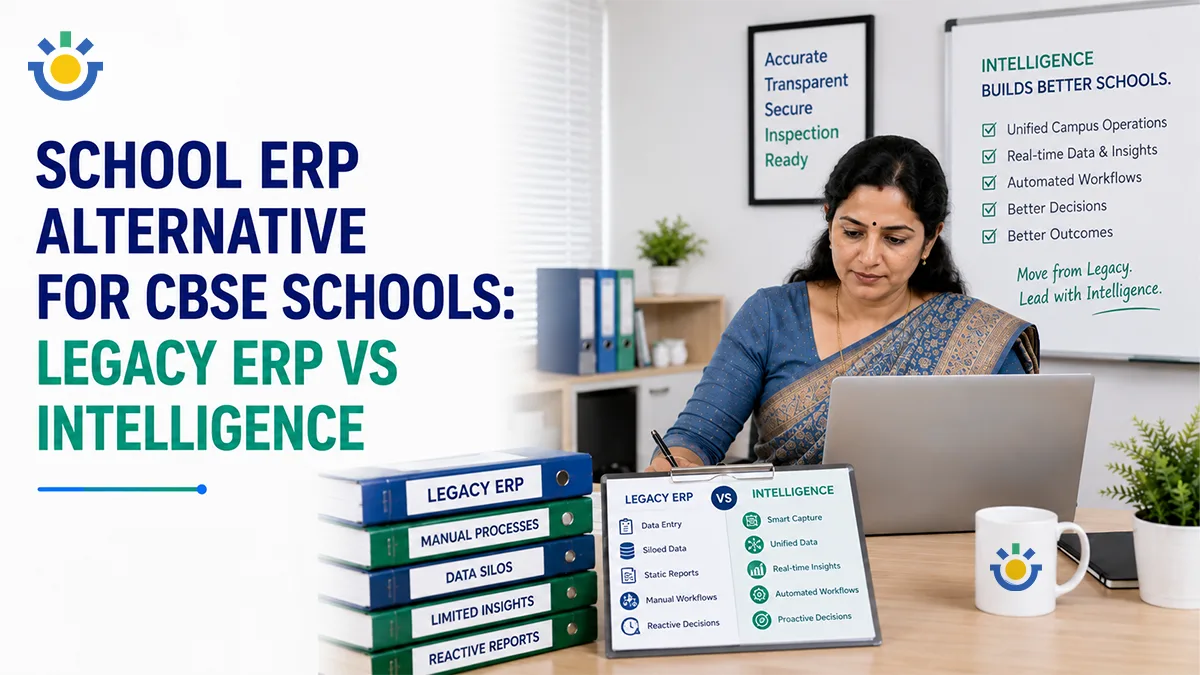
| Capability | Legacy School ERP (Entab, Fedena, Teachmint) | Learning Intelligence System (Ocoviz) |
| Primary Focus | Back-office administration & fee accounting | Academic outcome prediction & early risk detection |
| Data Nature | Post-mortem historical logging | Real-time pattern correlation & trend forecasting |
| Parent Communication | In-app push / SMS (often unread) | Native WhatsApp alerts with actionable insights |
| Academic Depth | Raw mark entry & simple averages | Concept-level learning gap detection & CBSE mapping |
| Intervention Speed | Reactive (after report cards are generated) | Proactive (2–4 weeks before assessment) |

What the Incumbents Genuinely Solved: The 2010 Digital Miracle
Let’s be completely fair to the pioneers.
Fifteen years ago, running a 2,000-student CBSE school in India was a logistical nightmare. Principals managed room-sized file cabinets filled with paper registers, handwritten fee receipts, and physical circulars that ended up crumpled at the bottom of school bags.
Platforms like Entab CampusCare, Fedena, and MyClassboard solved a massive real-world problem. They digitised the back office. They gave trustees automated fee reconciliation, gave transport managers GPS tracking, and gave admin staff a way to print thousands of report cards without losing their minds every March. Later, Teachmint arrived and streamlined digital classroom management and mobile-first attendance during the remote learning pivot.
They got the operational foundation right. And for 2010, that was enough.
Why Record-Keeping Stopped Being the Whole Problem
Think of your school software like Spotify.
A legacy ERP is like an old MP3 player—it holds all your songs neatly, lets you sort by track name, and plays them when you hit click. It stores data. But Spotify doesn't just store songs; its algorithm notices you listened to three slow acoustic tracks on a rainy Tuesday evening and builds a playlist tailored to your mood before you even ask.
Most school software is still stuck in the MP3 era.
It stores marks, tallies attendance percentages, and generates ledger reports. But storing data isn't the same as understanding it. When a Class 9 student drops from 80% to 55% in algebra over two months, a traditional ERP logs the numbers in a cell. It doesn't notice that the drop correlates with three missed classes during the quadratic equations module combined with a 15% dip in science scores.
It keeps the record. It misses the story.
The Structural Limit: "Attendance Fell" vs. "Student Will Fail"
Here is the fundamental wall every traditional ERP hits: they are built on post-mortem architecture.

An ERP tells you what already happened. It records that a student was absent 6 times last month or scored 12 out of 30 on a unit test. By the time that data reaches a coordinator's desk, the term is over, the report card is printed, and the student has already lost confidence.
A Learning Intelligence System operates on live signals. By connecting daily formative performance, attendance subtle shifts, and micro-assessment outcomes through a centralized Risk Radar, leadership gets an early warning 14 to 21 days before a major assessment.
The Difference in Real Life:
- Legacy ERP Alert: "Student X scored 32% in Mathematics Term 1 Exam."
- Learning Intelligence Alert: "Student X has a 78% probability of failing the upcoming physics unit because they missed 2 core conceptual lessons on Newton's Laws and failed the follow-up practice streak."
Honest Breakdown: Where the Incumbents Sit Today
When evaluating a school ERP alternative for CBSE schools, you don't need a glossy sales brochure; you need an honest diagnostic of what exists in the Indian market.
1. Entab CampusCare
- The Good: Incredible depth in fee accounting, auditing, and financial reconciliation for established, high-capacity schools.
- The Reality: The interface feels like a desktop software suite from 2012. It requires significant staff training, lacks real-time academic analytics, and relies heavily on SMS notifications that parents rarely open.
2. Fedena
- The Good: Highly modular, flexible open-source origin with 50+ administrative extensions.
- The Reality: High operational complexity. Customization often requires technical overhead, and the core student module remains a passive database rather than an active insight engine.
3. Teachmint
- The Good: Smooth mobile interface, great live-classroom infrastructure, and rapid teacher onboarding.
- The Reality: Built initially for hybrid teaching and classroom management. It lacks deep CBSE-compliant academic risk profiling, multi-tier institutional governance, and deep learning-gap analysis for long-term academic tracking.
4. MyClassboard & Vidyalaya
- The Good: Strong regional market presence with dependable operational administration and fee collection modules.
- The Reality: Excellent back-office tools, but completely blind to pedagogical intelligence, student engagement trends, and predictive learning analytics.
What a Learning Intelligence System Adds on Top (Without Breaking Your Operations)
You don't need to throw away fifteen years of operational stability to get modern academic insights.
A Learning Intelligence System—like Ocoviz—acts as an intelligent decision layer. While your daily administrative routines continue smoothly, the system runs silent, continuous analysis across every student touchpoint.

1. Automated Risk Detection: Flags struggling students weeks before mid-terms using multi-variable signal correlation.
2. Board-Compliant Report Generation: Generates print-ready, CBSE-aligned report cards through an integrated Report Studio in seconds rather than weeks.
3. Multi-Campus Command Center: Allows trustees and directors to monitor learning trends across multiple schools using real-time Multi-Campus Analytics.
4. Parent Communication That Works: Delivers fee updates, attendance alerts, and academic progress reports directly via WhatsApp where parents actually engage—cutting down staff follow-up load by up to 60%.
Migration Reality: What Happens to 8 Years of Historical Data?
The single biggest fear holding school principals back from upgrading software is data loss. “We have eight years of student records, alumni marks, and fee histories sitting in our current ERP. How could we possibly move?”
Modern cloud deployment has completely eliminated this headache.

- Zero Historical Data Loss: Your existing database (student archives, historic marks, ledger histories) is imported via automated mapping scripts without manual re-entry.
- 48-Hour Deployment: Because the system is cloud-native and pre-configured for CBSE, ICSE, and State Board structures, setup takes days—not months.
- Parallel Transition: Your admin staff can run fee collection and daily attendance immediately through a clean, modern interface while academic analytics start generating insights from day one.
How to Run the Evaluation: 5 Questions to Put to Any Vendor
Before you sign another annual contract with a legacy vendor or consider a Fedena alternative in India, ask their sales team these five simple questions:
- "Can your system tell my HODs which Class 9 students are at risk of failing science at least three weeks before the exam happens?"
- "Do fee reminders and academic updates go out via native WhatsApp with direct payment links, or are you still relying on unread SMS and app push notifications?"
- "How many clicks does it take a class teacher to generate a fully compliant CBSE Term 1 report card with skill descriptors?"
- "Can our management board view cross-campus learning loss indicators on a single mobile screen without exporting Excel spreadsheets?"
- "Does your platform analyze concept-level learning gaps, or does it only store final numerical marks?"
If they answer "No" or "That requires custom development" to more than two of these, you are looking at a 2010-era record register—not a modern school operating system. Discover the detailed findings in our comprehensive State of School Intelligence in India 2026 report.
Practical Takeaways for School Leaders
- Audit your current software usage: Ask your teachers how many hours they spend manually entering marks versus acting on student data.
- Shift focus from post-mortem to proactive: Evaluate software based on its ability to flag academic risks before assessments take place.
- Prioritize native communication channels: Move away from legacy SMS and standalone apps toward native WhatsApp integration to ensure parents actually read school updates.
- Demand 48-hour onboarding: Reject multi-month software implementations that disrupt school operations and overburden non-technical staff.
Conclusion
Fifteen years ago, digitizing your attendance register and fee counter was an act of leadership. Today, it’s merely table stakes.
The best schools in India aren't winning because they have cleaner digital spreadsheets—they're winning because they notice when a child is struggling long before the report card makes it obvious. It’s time to move past software that simply remembers what happened yesterday, and adopt intelligence that helps you shape what happens tomorrow.
The Comparison Block
| Metric / Feature | Traditional School ERP (Entab / Fedena / Teachmint) | Learning Intelligence Operating System (Ocoviz) |
| Primary Objective | Administrative workflow automation & fee logging | Predictive student learning outcomes & risk reduction |
| Academic Gap Analysis | Basic grade average calculations | Multi-dimensional concept & skill gap detection |
| Parent Engagement Channel | Standard SMS & app push notifications (Low open rate) | Direct, automated WhatsApp messaging (98%+ open rate) |
| CBSE Report Card Setup | Manual template mapping & heavy Excel exports | Instant, board-compliant automated report studio |
| Multi-Campus Governance | Separate logins or manual report aggregation | Real-time consolidated executive command dashboard |
| Implementation Speed | 4 to 8 weeks with heavy staff training | Full onboarding & data migration within 48 hours |
Frequently Asked Questions
How can school leaders track student progress without spending hours on spreadsheets?
With Ocoviz, administrators eliminate manual Excel consolidation entirely. The centralized dashboard synthesizes student performance trends automatically, giving principals and department heads instant clarity on learning gains and conceptual bottlenecks across all grades.
Why are traditional school ERPs failing to improve academic outcomes in CBSE schools?
While legacy systems record exam marks after the fact, the system provided by Ocoviz acts as a proactive decision layer. It correlates behavioral and academic indicators early in the term, allowing teachers to deliver targeted interventions weeks before board or unit exams take place.
What is the difference between a school ERP and a Learning Intelligence System?
While legacy platforms handle back-office transactions, the ecosystem built into this platform bridges administration with academics. It turns routine data entry into early-warning risk radar alerts, CBSE-aligned reporting, and real-time learning gap analytics.
How does modern school management software reduce teacher administrative workload?
By replacing clunky legacy menus with the streamlined tools inside the platform, educators save up to 12 minutes per day on routine administrative tasks. This allows teachers to spend less time re-keying marks into multiple spreadsheets and more time delivering impactful classroom instruction.
How can schools migrate years of historical ERP data without operational downtime?
The deployment framework behind the centralized dashboard enables complete data transfer—including past student records, fee ledgers, and academic histories—in under 48 hours. This ensures uninterrupted daily administration while instantly upgrading the school’s analytical capabilities.
Why is WhatsApp integration critical for modern school parent communication?
Unlike standalone app push notifications or traditional SMS messages that often go unread, the messaging engine powered by Ocoviz lands announcements directly in parents' primary communication app. This improves parent response times and significantly reduces administrative follow-up calls.
Stop Storing Student Data. Start Using Learning Intelligence.
See how top CBSE schools in India use Ocoviz to detect student learning gaps 3 weeks early, automate board report cards, and cut admin workload—all in one 48-hour deployment.
Book a 15-Minute Live Demo