Punjab Made AI a Core Subject for 31 Lakh Students. Here Is Your CBSE School’s 2027 Admissions Pitch
Key Takeaways
- Punjab launched Sarbat.AI, integrating AI as a core subject from Classes 1 to 12 across 25,000+ government schools for 31.5 lakh students.
- The initiative operates heavily as a massive teacher-training pipeline, aiming to upskill 2,00,000 educators to embed AI tools into everyday pedagogy.
- Convergence with simultaneous AI moves from NCERT, HAILM, and CBSE means teaching AI as a standalone textbook subject is no longer a private school differentiator.
- Government schools in tier-2 and tier-3 cities like Ludhiana or Bathinda now offer structured AI education at zero tuition cost.
- Private CBSE schools must shift their 2027 admissions pitch from "We teach AI" (curriculum) to "We run on AI" (institutional infrastructure).
Imagine a prospective parent walking into your admissions counselor's office in Ludhiana, Jalandhar, or Amritsar next month. They are taking a tour of your campus, admiring the air-conditioned classrooms and robotics kits. Then the father asks a simple question: "The local government senior secondary school down the road is teaching AI algorithms to Class 6 students under the Sarbat.AI program—for free. What exactly are you doing with AI here?" If your counselor's answer is "We have a weekly computer period where students learn basic coding and play with ChatGPT," you just lost that family. In late July 2026, the ground shifted beneath Indian K-12 education. In a single week, state and national authorities launched massive AI learning initiatives. The old private school playbook of framing "AI" as a premium extracurricular activity is officially obsolete.
The Direct Answer:
The launch of Sarbat.AI in Punjab schools along with concurrent AI rollouts from NCERT and CBSE has democratized AI education across state systems. Private CBSE schools can no longer differentiate themselves simply by adding AI to their curriculum; they must demonstrate that AI acts as an active, real-time Learning Intelligence Operating System powering personalized student growth.
The Quick-Scan Parameter:
- The State Benchmark (Sarbat.AI): 31.5 lakh students, Classes 1–12, 25,000+ state schools, 2,00,000 teachers being trained.
- The Market Shift: AI as a textbook subject = Baseline expectation (Commoditized).
- The Private Differentiator: AI as institutional infrastructure = Real-time student analytics, 24/7 personalized tutoring, and predictive early-warning systems.
What Sarbat.AI Actually Is: Scale, Phases, and the Missing Headline
When Punjab's Education Department launched Sarbat.AI, national headlines focused primarily on the staggering numbers: 3.15 million students across more than 25,000 government schools getting a structured AI curriculum spanning Classes 1 through 12.
Phase 1 establishes foundational AI literacy, while Phase 2 introduces hands-on applications, ethics, and basic machine learning concepts.

However, what mainstream coverage missed was the engine beneath the curriculum. Sarbat.AI isn't just a student syllabus—it is a massive teacher-training program disguised as a subject. With over 12,400 teachers already trained toward a target of 2,00,000 educators, the state is actively building an AI-literate teaching workforce.
The 7-Day National Convergence: NCERT, HAILM, and CBSE
The Sarbat.AI rollout didn't happen in a vacuum. During the exact same week in late July 2026, three other major announcements dropped across the Indian educational landscape:
- NCERT's AI Learning Modules: Standardized foundational AI concepts introduced for national frameworks.
- HAILM (High-Array Indian Language Models): Multilingual AI frameworks designed to integrate regional languages into digital learning.
- CBSE's Updated AI Skill Subjects: Expanded skill-education mandates encouraging affiliated schools to integrate practical AI tools across subjects.

The uncomfortable reality for private school trustees is stark: A student in a government school in rural Punjab now has access to structured, state-backed AI learning modules at zero tuition cost.
If a government school offers AI as a standard subject, "We teach AI" is no longer a value proposition for private school fees.
Curriculum vs. Infrastructure: Where Private Schools Must Win
To win admissions in 2027, private CBSE schools must recognize the difference between AI as a Subject (Curriculum) and AI as an Infrastructure (Systemic Intelligence).

Teaching students what an algorithm is for 45 minutes on a Thursday is passive learning. Running an institution where an adaptive platform actively maps each student's learning gaps in real time—that is institutional infrastructure.
When parents evaluate your school, they aren't looking for another textbook. They want to know how technology speeds up their child's academic progress, catches learning drops early, and provides round-the-clock support.
Reframing the 2027 Admissions Pitch: What to Say to Parents
When prospective parents ask, "What are you doing about AI?" during school tours for the 2027-28 academic session, move away from talking about syllabus chapters. Present a clear, three-part operational pitch:
1. "AI isn't just a chapter in our computer book; it's our students' 24/7 study partner."
Explain that while state curriculums teach about AI, your students actively use interactive tools like a 24×7 Doubt Solver. When a Class 9 student gets stuck on a complex Physics numerical at 9:30 PM, they don't have to wait for private tuition the next day—their smart learning assistant guides them step-by-step through the underlying concepts immediately.
2. "Our teachers use AI to mentor, not just mark attendance."
Demonstrate how your faculty uses automated tools like Learning Co-Pilots to reduce administrative overhead. Because teachers save hours on routine lesson planning and grading, they spend more one-on-one time addressing individual student learning needs.
3. "We track academic health in real-time, preventing exam-season surprises."
Show parents that your school uses a centralized KnowledgeHub to track formative assessments, attendance, and conceptual mastery continuously. Instead of discovering a drop in performance on the final report card, your leadership team identifies learning gaps weeks in advance.
Schools that demonstrate this level of operational depth earn recognition like the Ocoviz Smart School Badge, giving parents tangible proof that their tuition fees fund a modern, technology-enabled environment.
Practical Takeaways:
- Reposition your marketing: Audit your school prospectus and website to remove generic "AI Literacy" claims and highlight real-time learning systems instead.
- Train your admissions counselors: Equip your front-desk team with specific answers contrasting passive classroom AI lessons with your active learning infrastructure.
- Deploy 24/7 learning support: Implement personal learning assistants so students get immediate academic help outside school hours.
- Empower your faculty: Provide teachers with co-pilot tools to automate administrative tasks, allowing them to focus on direct student mentorship.
- Benchmark your campus technology: Measure your institutional capabilities against modern standards to earn recognizable smart school credentials before the 2027 admissions cycle begins.
Conclusion: The launch of Sarbat.AI in Punjab proves that digital education is moving fast. When state systems make AI a free, universal subject, private schools must elevate their value proposition. The future of competitive CBSE schooling isn't about teaching students how AI works—it's about using intelligent technology to help every child succeed.
The Comparison Block
| Evaluation Dimension | State AI Curriculum (e.g., Sarbat.AI) | Traditional Private School ERP | Ocoviz Learning Intelligence |
| Primary Scope | Classroom textbook syllabus | Administrative record-keeping | Real-time academic intelligence |
| Student Support | Scheduled class periods | None (Static portals) | 24/7 adaptive doubt resolution |
| Teacher Impact | General digital literacy training | Manual grade entry & attendance | Automated co-pilots for lesson planning |
| Parent Value | Free public access | Basic fee & marks tracking | Live visibility into concept mastery |
| Admissions Impact | Baseline state expectation | Standard expectation | Key differentiator for 2027-28 |
Frequently Asked Questions
How does Punjab's Sarbat.AI program affect private CBSE schools in the state?
What is the difference between teaching AI as a subject and using AI as school infrastructure?
How can school leaders answer parent questions about AI during 2027 school admissions?
How does an AI Learning Intelligence Operating System support CBSE teachers?
Why is passive computer lab instruction no longer enough for competitive CBSE admissions?
How do 24/7 AI doubt solvers help improve CBSE student retention and results?
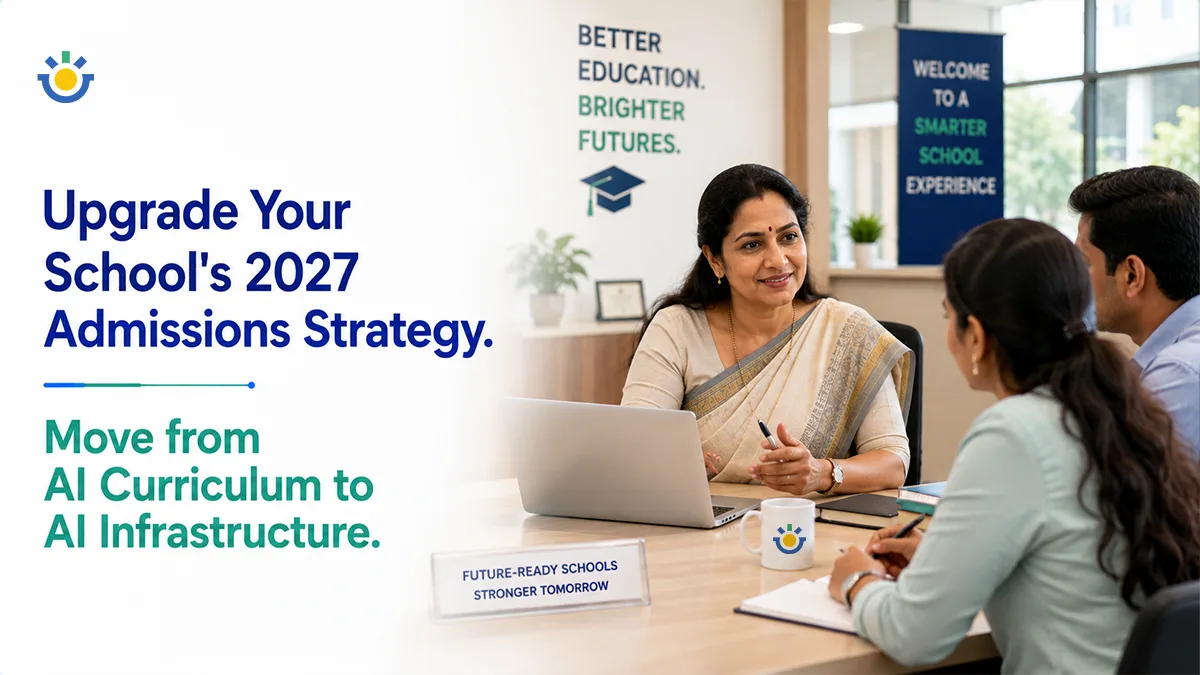
Upgrade Your School's 2027 Admissions Strategy. Move from AI Curriculum to AI Infrastructure.
Don't let government school initiatives outpace your admissions pitch. See how the Ocoviz (LIOS) equips your school with 24/7 student support, predictive analytics, and Smart School Badge.
See how to earn the Ocoviz Smart School Badge