The 14-Day Intervention Playbook: What a CBSE Teacher Actually Does in the Two Weeks After a Learning Gap Appears
Key Takeaways
- The 48 hours following a learning gap alert are critical; delay leads to compounding learning deficits.
- Effective remediation requires triaging the root cause into conceptual, attendance, or motivational friction.
- A structured 14-day intervention cycle focuses on micro-diagnostics, targeted practice, and quick re-checking.
- Low-stakes re-checking methods eliminate the need for heavy, time-consuming re-testing.
- Automating tracking tools enables teachers to execute personalized interventions even in 40+ student classrooms.
It’s Tuesday afternoon. You’re correction-pen in hand, working through a stack of Class 8 Mathematics answer sheets. Mid-way through, you hit Rahul’s paper. The first three problems on linear equations are completely blank; the fourth is a jumble of mismatched operations. The red flag is flying high. You know he’s lost. But the bell rings, Class 9 is waiting down the corridor, and tomorrow’s lesson plan on quadratic expressions is already set. What happens in the next 48 hours determines whether Rahul catches up or drifts silently into chronic academic lag.
The Direct Answer:
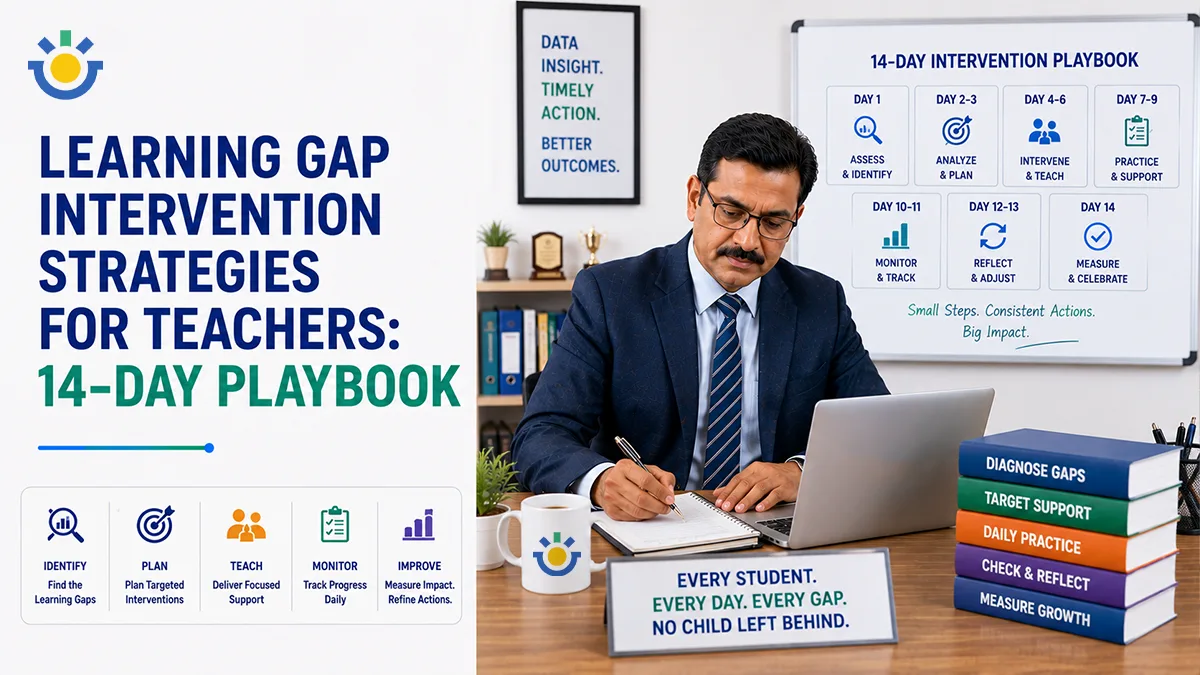
Closing a student learning gap requires moving beyond simple re-testing to a structured, 14-day intervention cycle. Teachers must triage the gap's root cause within 48 hours, run targeted micro-interventions (such as peer pairing or targeted problem sets), and conduct low-stakes re-checks to confirm mastery before moving forward.
The Quick-Scan Parameter:
| Phase | Timeline | Core Objective | Key Deliverable |
| Phase 1: Triage & Diagnosis | Days 1–3 | Isolate root cause (Concept vs. Attendance vs. Effort) | 4-Question Micro-Diagnostic |
| Phase 2: Targeted Intervention | Days 4–9 | Deliver precise re-teaching & practice | Targeted Practice Set / Peer Loop |
| Phase 3: Verification & Hand-off | Days 10–14 | Verify recovery without a full re-test | 5-Minute Micro-Check / Digital Record |
Why Detection Is the Easy Half—and Why Teachers Stall in the 48 Hours After the Flag
Spotting a learning gap in today’s classroom isn't the hardest part. Between weekly unit tests, classwork corrections, and automated grading dashboards, red flags pop up constantly. The real breakdown happens in the 48 hours right after the gap becomes visible.
Teachers don't stall because they don't care. They stall because the sheer volume of daily tasks creates decision paralysis.
When you are managing 40 students per period across five sections, seeing that a student scored 30% on a topic often leads to a heavy question: When am I supposed to find forty minutes to re-teach this single concept?
Without a clear, low-friction playbook, the default response is to write "Needs Improvement" in the margin, hope the student catches up during exam revision, and keep moving through the syllabus. But as highlighted in our study on the State of School Intelligence in India 2026 (the 14-day window), waiting for end-of-term revision turns a minor, fixable misconception into a deep, compounding learning deficit.

Triage: Separating a Concept Gap from an Attendance Gap from a Motivation Gap
Before you spend a single minute re-teaching, you need to diagnose why the gap exists. Treating every academic failure with the exact same remedial worksheet is like prescribing cough syrup for a broken arm. Effective learning gap intervention strategies for teachers start with quick triage into one of three distinct categories:

1. The Concept Gap (The Prerequisite Break)
The student was present, tried to pay attention, but lacks a prerequisite skill. For example, trying to teach algebraic factorisation to a student who never mastered negative integer operations. Re-explaining factorisation five times won't fix this—you must fix the underlying integer logic.
2. The Attendance Gap (The Missing Link)
The student missed four consecutive classes during the introduction of a core concept due to illness or an extracurricular event. Their issue isn't cognitive difficulty; it's simply a lack of instruction time. They don't need remediation; they need an efficient catch-up pathway.
3. The Motivation Gap (The Frustration Loop)
The student has stopped trying. They hand in incomplete worksheets, tune out during class, and say "I don't get it" before reading the question. This usually happens when past failures build up, making task avoidance feel safer than trying and failing again.
To identify these patterns early across your entire roster, smart monitoring platforms like Risk Radar flag specific student risk profiles before small issues snowball into major setbacks.
Days 1–3: The Diagnostic Conversation and the Four Questions That Locate the Break Point
Once you have triaged the issue, set aside three minutes for a 1-on-1 diagnostic conversation. This isn't a lecture—it's a quick investigation.
Avoid asking open-ended questions like "Why didn't you understand this?" (which usually gets a blank stare or an "I don't know"). Instead, walk the student through a sample problem and ask these four specific questions:

- "Read the problem aloud to me. What is it asking us to find?"
- What this reveals: Is this a language/reading comprehension barrier rather than a subject-matter gap?
- "What is the very first step you would take here?"
- What this reveals: Does the student recognize the starting point, or are they stuck at the entry level?
- "Why did you choose to move from this step to that step?"
- What this reveals: Is the student following a memorized recipe without understanding the underlying logic?
- "Show me the exact spot where you started feeling unsure."
- What this reveals: pinpointing the exact breakdown point saves you from re-explaining things the student already understands.
Days 4–9: The Intervention Itself—Choosing the Right Pathway
Once you locate the break point, pick one of four targeted pathways for Days 4 through 9. Avoid trying to do all four—choose the path that fits your diagnostic findings.

Pathway A: The Micro Re-Teach (10 Minutes of Focused Direct Instruction)
If the student has a fundamental conceptual gap, sit down with them during independent work time or a proxy period. Use a different representation than the one used during the main lesson. If you originally taught the concept symbolically, switch to a visual model or a real-world analogy.
Example: If a student struggles with fractional division, move away from the "flip and multiply" rule. Use physical paper strips or visual diagrams to show how many quarter-pieces fit into two whole units.
Pathway B: The Structured Peer Pair
If the issue is procedural confusion rather than a complete conceptual block, pair the student with a classmate who recently mastered the topic.
Do not simply say "help him out." Structure the interaction clearly:
- Step 1: The peer mentor solves a problem out loud, explaining their thinking.
- Step 2: The target student solves a similar problem out loud, talking through their steps.
- Step 3: The peer mentor offers feedback using a simple checklist provided by the teacher.
Pathway C: The Targeted Micro-Practice Set
When a student suffers from practice deficits, handing them a 30-question remedial worksheet often triggers frustration and avoidance.
Instead, assign a 5-question targeted practice set using the Homework Hub. Ensure the questions follow a strict progression:
- Questions 1 & 2: Low complexity (builds confidence and checks entry-level steps).
- Questions 3 & 4: Standard grade-level complexity (checks core application).
- Question 5: Moderate challenge (verifies stable mastery).
Pathway D: The Parent Loop (For Attendance or Persistence Gaps)
If the gap stems from chronic absenteeism or incomplete homework, bring parents into the loop early. Avoid sending vague messages like "Rahul needs to study harder." Send an actionable update instead:
"We noticed Rahul missed the introductory lessons on linear equations last week. We have assigned a short 10-minute catch-up exercise on his dashboard. Please ensure he completes this specific assignment by Thursday evening so he stays on track for next week's classes."
To keep learning support aligned across home and school, educators use adaptive tools like Learning Co-Pilots to send targeted, bite-sized practice directly to students based on their personal skill gaps.
Days 10–14: The Re-Check That Tells You Whether It Worked (Without Another Full Test)
By Day 10, the intervention is complete. Now you need to verify if it worked. The biggest mistake teachers make here is administering another full-length test. Creating, administering, and grading a whole new exam adds unnecessary work for you and stress for the student.
Instead, execute a Micro Re-Check between Days 10 and 14 using one of three quick methods:

1. The Two-Question Exit Ticket
Hand the student a slip of paper with two targeted questions at the end of a class period.
- Question A: Checks if the original misconception has been cleared.
- Question B: Checks if they can apply the fix independently to a slightly altered problem.
2. The 60-Second Whiteboard Slate
During the first five minutes of class warm-up, give the student a mini-whiteboard and a single problem. As you walk around the room checking attendance, glance at their response. A quick glance gives you immediate visual proof of mastery without any papers to take home.
3. The "Explain It Back" Check
During a brief transition, point to a solved problem on the board and ask the student: "Explain to me why we moved the constant term over in step two." If they can articulate the underlying reason in two sentences, the gap is closed.
Documenting It So the Next Teacher Inherits the Context Instead of Restarting
Closing a learning gap takes real time and effort. Don't let that valuable diagnostic context disappear when the student moves to the next grade or section.
If a teacher spends two weeks discovering that a student grasps mathematical concepts easily through visual diagrams but struggles with multi-step word problems due to vocabulary barriers, that insight needs to follow the student.

Instead of letting these observations fade into memory, educators use the Academic Tracker to record student growth stories, successful strategies, and ongoing learning needs. When the next teacher receives the class roster in April, they inherit a clear roadmap of what works, preventing the need to restart the diagnostic process from scratch.
Where This Breaks at 40 Students Per Class—and What Has to Be Automated
Let's be realistic: managing a 14-day manual intervention cycle for one student is completely doable. Managing it manually for fifteen struggling students across four different sections of forty kids each is a fast track to teacher burnout.
When you try to execute this framework manually across large classes, three main operational bottlenecks occur:

This is where automated systems become essential. You shouldn't spend hours searching through marksheets, hand-crafting five different versions of a practice worksheet, or keeping track of intervention schedules on sticky notes.
Modern academic management tools handle the administrative load automatically:
- Automated Gap Flagging: Systems aggregate daily marks and instantly highlight concept-level gaps.
- Smart Content Generation: Platforms automatically build targeted 5-question practice sets tailored to a student's specific break point.
- Timeline Tracking: Intelligent dashboards automatically schedule re-checks and track progress, letting you know when a student successfully completes their 14-day cycle.
By offloading administrative logistics to an automated platform, you can focus on what matters most: delivering high-impact, human-centered teaching that keeps every student moving forward.
Practical Takeaways for CBSE Teachers
- Execute Triage Within 48 Hours: Classify learning gaps into Concept, Attendance, or Motivation categories before assigning remediation.
- Use 3-Minute Micro-Diagnostics: Ask the 4 targeted diagnostic questions to locate the exact breakdown point before re-teaching.
- Limit Remedial Assignments: Keep practice targeted—assign 5 well-structured questions rather than overwhelming students with 30-question worksheets.
- Swap Full Exams for Micro Re-Checks: Confirm mastery on Days 10–14 using exit tickets or 60-second whiteboard checks.
- Log Successful Strategies Digitally: Record effective intervention methods in a centralized system so future teachers retain valuable context.
Conclusion
Detecting a learning gap is only the starting point—what you do in the two weeks that follow is what truly shapes a student's academic path. Closing gaps doesn't require complex overhauls or endless hours of evening grading. By following a structured 14-day playbook—triaging early, targeting interventions, verifying with low-stakes checks, and leveraging digital tools to handle tracking—you can prevent students from slipping through the cracks while keeping your teaching workload balanced and sustainable.
Comparative Matrix of Student Intervention Methods
| Intervention Strategy | Teacher Effort | Time Required | Typical Effectiveness | Best Used For |
| Generic Homework Sheets | High (Manual grading) | 60+ minutes/week | Low (Triggers task avoidance) | General revision only |
| Peer-Assisted Learning | Low (Teacher facilitates) | 15 minutes/class | High (Builds confidence) | Procedural fluency gaps |
| Micro Re-Teach (Visual) | Moderate (1-on-1 focus) | 10 minutes/session | Very High (Fixes core logic) | Deep conceptual blocks |
| Automated Adaptive Practice | Very Low (System generated) | 10 minutes/day | High (Targeted skill building) | Skill practice & re-checking |
Frequently Asked Questions
Q1: How can a teacher close learning gaps in class without falling behind on the CBSE syllabus schedule?
Q2: What is the most effective student intervention plan for CBSE classrooms with over 40 students?
Q3: How do you differentiate a concept gap from a motivation gap in secondary school students?
Q4: Why are traditional remedial teaching plans in CBSE schools often ineffective?
Q5: How can teachers re-check student mastery after an intervention without spending hours grading?
Q6: What is the ideal timeframe for executing a remedial intervention after identifying an academic drop?
Stop Letting Learning Gaps Turn Into Chronic Lag
Equip your teaching staff with automated gap detection, smart practice generation, and seamless progress tracking to close learning gaps in 14 days or less.