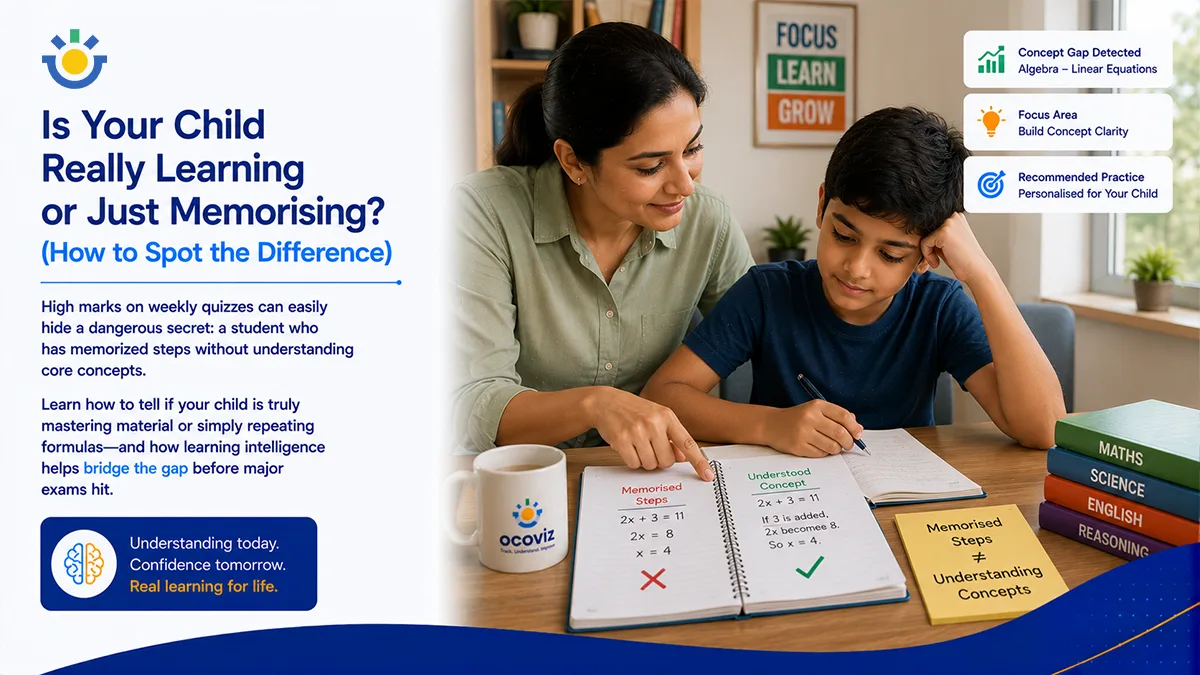
Is Your Child Really Learning or Just Memorising? (How to Spot the Difference)
Key Takeaways
- Rote memorization creates an illusion of competence through surface repetition, whereas deep learning enables real-world problem-solving.
- Children relying on memorization usually struggle when questions are rephrased or applied outside standard textbook contexts.
- Multi-dimensional diagnostic signals can identify conceptual gaps weeks before formal exam scores plummet.
- Ocoviz uses Socratic, step-by-step AI tutoring to prompt reasoning instead of handing out copy-paste answers.
- Shifting home study from "What is the answer?" to "Why does this work?" builds long-term critical thinking.
Picture this: Your 7th grader brings home an A+ on a Friday science worksheet. They recited every definition of photosynthesis flawlessly, spelled the terminology correctly, and finished their homework in twenty minutes flat. Everyone feels relieved.
Fast forward three weeks. You tweak the question slightly over dinner: "If we keep a plant in a room with only green light, will it still make food?"
Silence. A blank stare. Then the uncomfortable realization: "We didn't cover that exact question in class."
This quiet moment of friction happens in millions of homes every evening. Our educational system has trained kids to become expert copy-paste engines. They memorize steps, store formulas long enough to pass Friday's quiz, and dump the information from their brains by Sunday night. On paper, they look like top performers. In reality, their understanding is paper-thin—and the moment a test rephrases a prompt, the entire foundation crumbles.
The Direct Answer:
The difference between memorisation and real learning lies in application. Rote memorization relies on surface repetition to pass specific tests, while genuine conceptual learning allows a student to explain why a concept works and apply it to unfamiliar, real-world problems.
The Quick-Scan Parameter:
- Surface Indicator: High quiz scores paired with intense anxiety when questions are slightly rephrased.
- Deep Learning Sign: Ability to teach the concept back to a parent using everyday analogies.
- Diagnostic Detection: Identifying underlying conceptual gaps 2–4 weeks before terminal exams.
- Pedagogical Fix: Socratic scaffolding that guides reasoning rather than outputting direct answers.
What Is the Difference Between Rote Learning and Critical Thinking?
To understand why so many high-scoring students panic during final exams, we have to look at how information is stored in the brain.
Rote memorization acts like a mental filing cabinet. The child stores isolated facts—formulas, dates, definition blocks—without linking them together. Critical thinking, on the other hand, builds a connected web of understanding.
ROTE MEMORISATION: Input Fact > Store in Short-Term Memory > Exam Dump
CONCEPTUAL LEARNING: Input Fact > Connect to Logic > Transferable Skill
When a child relies on memorization, they depend on identical phrasing. If an exam asks, "What is $A$?" they score $100\%$. If the exam asks, "How does $A$ influence $B$ under condition $C$?" they freeze.
How Can Parents Spot Hidden Learning Gaps at Home?
You don't need a teaching degree to figure out if your child is actually comprehending their schoolwork. You just need to ask the right kind of questions during daily study sessions.
| Acid Test | How to Do It | What It Reveals |
| Rephrase the Question | Change the names, numbers, or context slightly while keeping the same concept. | Flexibility of Understanding — Can the student apply the concept in a new situation? |
| Ask for an Analogy | Ask the student, "Explain this to your younger sibling." | Clarity of Understanding — Can they simplify and truly explain the concept? |
| Trace the "Why" Chain | Ask "Why?" three times after each answer to uncover the reasoning behind it. | Depth of Understanding — Do they understand the underlying principles, not just the final answer? |
| If a child gets defensive or complains that "that's not how the teacher wrote it," you are looking at a memorization safety net that is about to snap. |
How Does Learning Intelligence Detect Fake Mastery Before Exams?
In a busy classroom of thirty or forty children, even the most dedicated teacher cannot spot every child who is silently relying on rote memory. On the surface, their homework comes in completed and their attendance is steady.
This is where technology changes the game. By analyzing subtle, background interaction signals such as how long a student deals with problems or how they pass their educational obstacles Ocoviz acts as a early-warning radar.
"When we only look at final marks, we miss the silent warning signs. True learning intelligence tracks how a student arrives at their answer, not just whether they clicked the right box." State of School Intelligence in India Report
When an underlying gap is detected in foundational math or science concepts, the platform flags it immediately on the parent and teacher dashboard. Instead of discovering a flaw on the end-of-term report card, parents receive actionable insight weeks in advance.
Furthermore, when students need extra help at home, the built-in 24/7 AI tutor for step-by-step doubt solving avoids handing over instant answers. It asks guiding questions that force the child to engage their reasoning muscle, converting surface memory into deep understanding.
Practical Takeaways for Parents
- Swap "What did you get?" for "How does it work?": Focus dinner conversations on the reasoning process rather than raw test percentages.
- Test with context shifts: When reviewing homework, change the numbers or scenario slightly to see if the logic holds up.
- Encourage Socratic dialogue: Ask your child to teach a difficult chapter back to you in their own words.
- Monitor early trend alerts: Use your centralized parent dashboard to spot conceptual struggles weeks before formal exams.
Conclusion
Memorization isn't useless—we all need to remember multiplication tables and basic vocabulary. But when memory replaces comprehension, learning becomes a fragile house of cards.
By shifting our focus from quick answers to deep reasoning, we can help children build the critical thinking skills they need—not just to pass next week's exam, but to thrive in a complex world.
The Comparison Block: Memorisation vs. Genuine Learning
| Observation Dimension | Rote Memorisation | Genuine Conceptual Learning |
| Response to Rephrasing | High anxiety; struggles if wording shifts | Adapts easily; applies underlying principles |
| Retention Duration | Fades rapidly within days of the exam | Persists long-term in structural mental model |
| Problem-Solving Style | Follows memorized, rigid step steps | Tries alternative pathways to solve the issue |
| Doubt-Solving Need | Wants immediate final answer to copy | Asks "why" to understand where logic broke |
Frequently Asked Questions
How can I tell if my child is memorizing math formulas without understanding them?
Why do students who get good quiz scores suddenly fail major term exams?
How does a Learning Intelligence Operating System help bridge learning gaps at home?
What is the best way to help a child who struggles with application-based questions?
Can AI tools prevent students from copying answers during home study?
How early can automated analytics detect that a student is struggling in school?
Help Your Child Build Real Understanding That Lasts
Discover how Ocoviz gives parents clear, real-time insights into their child's true learning progress—detecting hidden gaps long before report card day.
See How Parent Insights Work