Two Board Exams, One Academic Year: Rebuilding the Class 10 Calendar After CBSE’s Dual Cycle
Key Takeaways
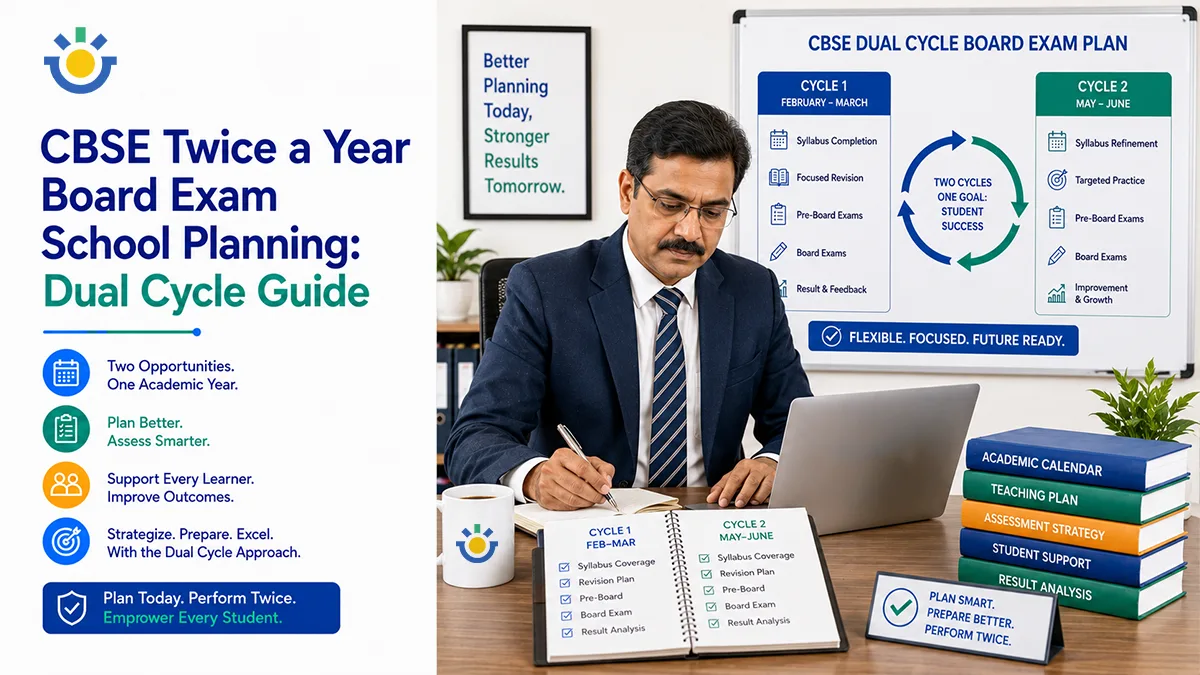
- CBSE completed its first dual-cycle Class 10 board exams with Phase 1 in Feb–March and Phase 2 in May–June.
- Internal assessments are conducted only once per academic session, carrying over regardless of how many Phase 2 papers a student attempts.
- Students skipping three or more subjects in Phase 1 lose Phase 2 eligibility entirely and are declared Essential Repeaters.
- The September List of Candidates (LOC) window is the vital operational deadline for setting subject choices and accommodations.
- Navigating dual board exam planning requires splitting the spring term into targeted revision and improvement cohorts.
Picture a typical middle school hallway on a sunny afternoon in mid-April. Half your Class 10 students are outside playing football, celebrating the end of their board exams with crisp new Class 11 textbooks tucked under their arms.
Down the corridor, in a quiet corner room, your senior math teacher is trying to review quadratic equations with the other half of the class—students who scored lower than expected in Phase 1 and are prepping for Phase 2 in May.
It feels a bit like running two different schools inside the same building. One group of kids has moved on, while the other is still running on exam stress.
When CBSE announced dual board exams, it sounded like a gentle safety net for students. But for the educators managing the timetable, it turned the traditional academic calendar upside down. Now that the first full dual cycle is complete, we can look at real data instead of guesswork to see how schools can adapt.
The Direct Answer
Navigating CBSE Class 10 dual board exams requires schools to finish the core syllabus by late November. This leaves December for pre-boards and sets up a split teaching calendar between March and May for students aiming to improve their scores in Phase 2.
Quick-Scan Parameter
| Academic Parameter | Legacy Single-Exam Model | CBSE Dual-Cycle Operating Model |
| Syllabus Deadline | Mid-January | End of November |
| Phase 1 Assessment Window | February – March | February – March (Results in April) |
| Phase 2 Assessment Window | Supplementary (July) | Mid-May – June 1 (Results in June) |
| Internal Assessment Policy | Single submission window | One-time mark lock (Carried into Phase 2) |
| LOC Planning Cutoff | Late September | September lock (Sets eligibility for both phases) |
What the Dual Cycle Looked Like in Practice
The dual-exam cycle is no longer just a proposal on paper—it's a working reality. Phase 1 ran from mid-February through March, with results arriving in April. Phase 2 kicked off in mid-May and wrapped up by June 1, delivering final best-of-two scores in late June.

The key take-away for administrators? Phase 2 isn't just an emergency re-test for failing students. It functions as a score booster for ambitious kids trying to raise a 78% to an 88% in specific subjects.
The Internal Assessment Rule That Changes Everything
One critical policy detail caught many schools off-guard during the first run: internal assessments are conducted only once per academic session.

Whether a student writes theory papers in Phase 1, Phase 2, or both, their practical grades, lab files, and portfolio marks are locked during the winter window. You cannot redo lab assessments in May to raise a total score—what gets entered in December stays permanent.
The Eligibility Trap and the September Deadline
The real deadline for managing dual exams isn't February—it's the September List of Candidates (LOC) submission.
Under board rules, if a student skips three or more theory subjects during the Phase 1 window, they are flagged as an Essential Repeat. That means they lose Phase 2 eligibility entirely and must repeat the year.

Admissions teams cannot treat September data entry as a routine task. You need to identify struggling students early to ensure they sit for their required Phase 1 papers and stay eligible for Phase 2.
Rebuilding the Teaching Calendar for November Completion
Fitting a full academic year into a compressed timeline requires adjusting how teachers pace their lessons.

- April to July: Cover 50% of the syllabus without skipping foundational concepts.
- August to November: Finish the remaining topics, complete lab practicals, and lock internal marks.
- December to January: Run targeted pre-board exams and review real sample papers.
- February to March: Sit for Phase 1 board examinations.
Managing the March-to-May Split Cohort
Once Phase 1 results arrive in April, your Class 10 cohort splits into two distinct groups.

Managing this split without burning out your teaching staff requires clear organizational planning.
Using diagnostic tools like an Assessment Hub helps teachers quickly spot learning gaps from Phase 1.
By tracking individual student performance in an Academic Tracker, coordinators can see exactly which kids need Phase 2 prep versus those ready to start Class 11 material.
Using centralized tracking tools—including systems like Ocoviz—allows schools to analyze test performance, automate grade reporting via Report Studio, spot academic flags using Risk Radar, and align institutional master schedules through an automated Calendar & Circulars engine.
Choosing Who Should Attempt Phase 2
Deciding which students should sit for Phase 2 should be based on clear performance data, not last-minute panic.

Guide students toward Phase 2 if:
- Their Phase 1 theory score was significantly lower than their internal pre-board averages.
- The score gap can be closed with 3–4 weeks of focused revision in one or two specific subjects.
- They maintained strong attendance and engagement throughout the spring term.
Advise students against Phase 2 if their Phase 1 score already matches their consistent performance level. In those cases, diving straight into Class 11 preparation is usually the better choice.
A Step-by-Step Checklist for School Leadership
- Set November 30 as your syllabus deadline: Adjust lesson plans across all departments to finish teaching before the winter break.
- Audit internal assessment files early: Complete all practicals, project files, and portfolio evaluations by early December.
- Run an LOC audit in September: Double-check student details and subject choices to ensure every child remains eligible for both phases.
- Create a spring transition timetable: Build a dual schedule for April and May that offers Class 11 bridge classes alongside Phase 2 review sessions.
- Track teacher invigilation hours: Spread exam supervision duties evenly across middle and senior school staff to avoid burnout during the May window.
Final Thought
Moving to a dual board exam system is a big operational shift, but it doesn't have to create chaos. By adjusting your syllabus timeline, locking internal marks early, and using real performance data to guide students, you can turn a complicated policy change into a smooth, stress-free process for your entire school.
Strategy Comparison: Traditional vs. Dual-Cycle Academic Planning
| Planning Metric | Traditional Annual Exam Framework | Dual-Cycle Operating Framework |
| Syllabus Completion Date | Mid-January | End of November |
| Internal Assessment Window | January – February | October – November (Locked once) |
| Spring Term Focus | New academic session start only | Dual-track: Class 11 prep & Phase 2 review |
| Exam Retake Access | Limited to compartment cases in July | Available to all students in May–June |
| Data & Tracking Requirement | Annual summary reports | Continuous term diagnostics and tracking |
Frequently Asked Questions
How does the CBSE twice-a-year board exam system work for Class 10?
Are internal assessment marks counted twice in the dual board exam system?
What happens if a student misses Phase 1 of the CBSE Class 10 board exams?
How should schools adjust their syllabus timelines for dual board exams?
Can a student appear for Phase 2 just to improve their score in a single subject?
How do dual board exams affect the transition to Class 11?
Ready to Simplify Your Dual Board Exam Planning?
See how Ocoviz streamlines syllabus tracking, internal grade locking, and Phase 1 vs. Phase 2 performance analytics.
Schedule an Academic Planning Demo