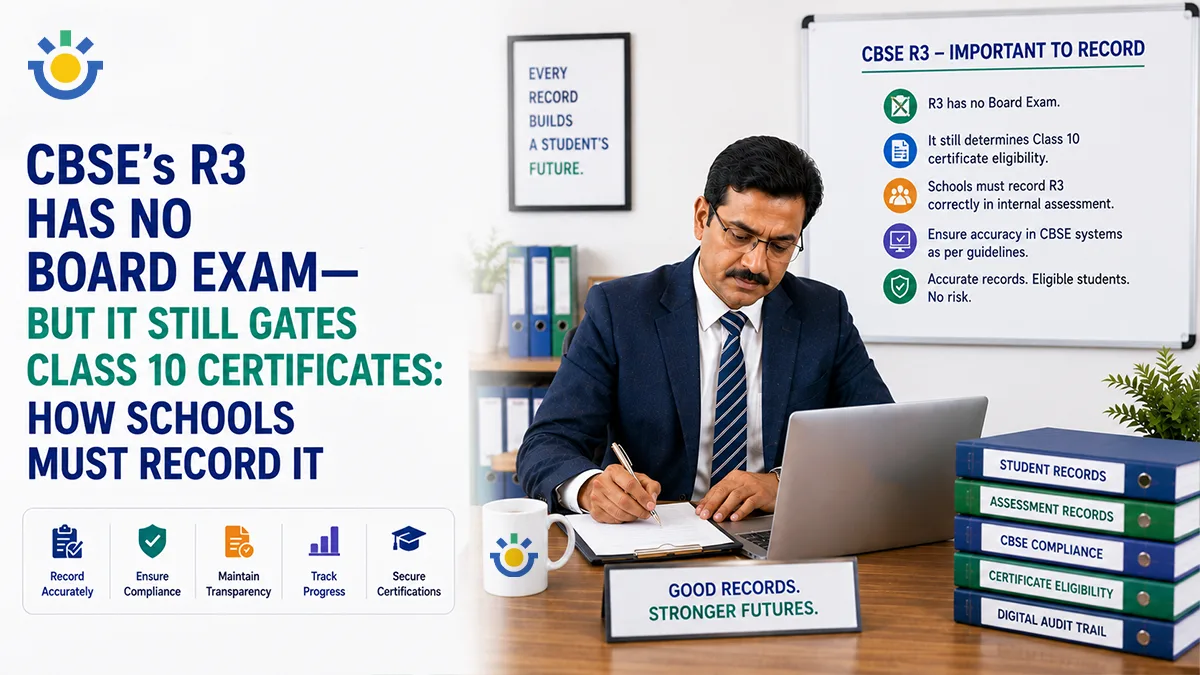
CBSE’s R3 Has No Board Exam—But It Still Gates Class 10 Certificates: How Schools Must Record It
Key Takeaways
- CBSE Circular Acad-33/2026 mandates a third language (R3) for Class 9 starting July 1, 2026.
- There is no external board exam for R3, but school-level internal assessment is mandatory to clear Class 10.
- Ongoing litigation does not grant a stay; schools must immediately establish defensible assessment records.
- Compliance requires tracking "functional proficiency" despite a lack of standardized secondary-level R3 textbooks.
Imagine a high school senior sitting for their final board exams, scoring 95% in Mathematics and Science, only to have their Class 10 pass certificate withheld because of a missing Class 9 third-language record sheet from two years prior. That isn't a hypothetical horror story—it is the literal operational reality created by CBSE Circular Acad-33/2026. While headlines focus on courtroom drama, academic coordinators are left holding the bag mid-session, trying to figure out how to evaluate functional proficiency without proper textbooks or specialist staff.
The Direct Answer:
CBSE Circular Acad-33/2026 mandates the implementation of a Regional/Third Language (R3) in Class 9 starting July 1, 2026. Although R3 lacks a centralized board exam, schools must conduct internal assessments; failing to properly record and report these internal marks prevents the issuance of the student's final Class 10 certificate.
The Quick-Scan Parameter:
| Metric / Parameter | Mandate Requirement |
| Applicability Date | July 1, 2026 (Academic Session 2026–27) |
| Assessment Type | 100% School-Level Internal Assessment (No External Board Exam) |
| Class 10 Pass Condition | Mandatory completion & recorded internal assessment in Class 9/10 |
| Target Skill Level | Functional Proficiency (A2/B1 equivalent) |
| Primary Audit Risk | Unrecorded mid-session enrollments & lack of physical evidence |
What Circular Acad-33/2026 Actually Requires From 1 July 2026
Strip away the policy jargon, and CBSE Circular Acad-33/2026 introduces a fundamental structural shift: every Class 9 student must be enrolled in a third language (R3) alongside their primary language subjects.
The mandate took effect on July 1, 2026. The intent behind the three-language policy Class 9 school compliance directive is to broaden linguistic exposure. However, because it was released right in the middle of an active academic term, schools must adjust quickly.
Unlike conventional core subjects, R3 is designed around conversational competence rather than literature-heavy memorization. Yet, "functional proficiency" remains a formal academic requirement that must be tracked, marked, and officially submitted to the board.

The Bit Schools Are Missing: No Board Exam, But Internal Assessment Still Gates the Certificate
Many administrative teams made a dangerous assumption when the circular dropped: No board exam means low priority.
That assumption will cause significant friction during Class 10 registration. While the board will not set a question paper or dispatch external invigilators for R3, it has made internal clearing mandatory.
If a student's internal assessment records for R3 are incomplete, flag red in the system, or lack verifiable evidence during a routine audit, the board will withhold the student's Class 10 pass certificate. The internal assessment isn't an optional extracurricular—it is a mandatory gatekeeper.
Where the Litigation Stands, and Why You Cannot Plan on a Deferral
On August 4, 2026, the Supreme Court issued notices to the Centre, CBSE, and NCERT regarding legal challenges against Circular Acad-33/2026. Because of these headlines, several school management teams are holding off on implementation, hoping for a stay order or a deferred timeline.
Operating on hope is a massive compliance risk.
Unless a formal stay order is issued by the judiciary or an official postponement circular is published on the CBSE portal, the July 1 mandate remains legally binding. If your school delays assessment recording until late in the term and the court upholds the circular, your staff will face a massive administrative backlog attempting to backdate assessments for hundreds of students.
The Three Operational Problems Now on Your Desk
School leaders are dealing with three distinct practical hurdles:
- No Secondary-Level R3 Textbooks: Standardized Class 9 textbooks tailored specifically for beginner-level R3 under this new framework are sparse. Teachers are scrambling to curate materials from lower grades or construct ad-hoc worksheets.
- Non-Specialist Teachers Handling "Functional Proficiency": Many institutions lack dedicated secondary-level language teachers for all regional options, forcing existing staff to manage conversational evaluations.
- Mid-Session Rollout: Integrating a new evaluation track into an academic year that is already underway creates schedule conflicts and administrative friction.
To maintain clarity, modern school leadership relies on the centralized dashboard to align departmental efforts and keep track of these unexpected regulatory updates.
Designing a Defensible R3 Internal Assessment: What to Record and How Often
When an audit occurs, subjective grades written in a register will not suffice. Schools need a defensible, evidence-backed evaluation framework.

Your CBSE R3 internal assessment Class 9 framework should measure four key pillars:
- Speaking Competence (30%): Short, 2-minute recorded oral vivas or conversational dialogues.
- Listening Comprehension (30%): Standardized audio-prompt quizzes assessing basic understanding.
- Reading Functional Texts (20%): Evaluation based on real-world reading tasks (signs, simple notices, basic passages).
- Short-Form Writing (20%): Brief practical writing tasks (filling out forms, short messages).
Instead of relying on paper binders that are easily misplaced, academic leaders use the Report Studio to aggregate rubrics, track skill-wise progression, and generate clean student profiles with a single click.
Carrying a Pending R3 Assessment Forward into Class 10 Without Losing the Trail
Student mobility creates administrative headaches. When a student transfers schools between Class 9 and Class 10, their R3 evaluation history must move seamlessly with them.
If a transfer student arrives at your school with missing R3 internal marks from their previous institution, your school becomes vulnerable during board registration. You need a continuous tracking system.
By logging every assessment event into the Academic Tracker, schools maintain a permanent digital record of student learning trajectories. This guarantees that when Class 10 registration rolls around, all prerequisite internal credits are verified and ready for submission.
To streamline this tracking process across all departments, school leaders can leverage a structured analytics platform.
Practical Takeaways for School Leaders
- Establish an R3 Compliance Log: Digitally capture every R3 assessment event starting this week.
- Standardize Assessment Rubrics: Supply teachers with simple 1–5 scale rubrics for listening and speaking evaluations.
- Archive Auditable Evidence: Store audio recordings or physical portfolio sheets for at least 15 months to handle board verification requests.
- Audit Transfer Students Immediately: Inspect Class 9 transcripts for mid-session transfer students to verify R3 compliance.
- Centralize Internal Marks: Utilize the Assessment Hub to track R3 completion alongside core subjects, ensuring no student drops below the mandatory threshold.
Conclusion
CBSE Circular Acad-33/2026 may feel like an administrative burden dropped in the middle of the school year, but it doesn't have to trigger operational chaos. The absence of a board exam isn't an invitation to ignore the mandate—it's a prompt to build a simple, repeatable internal recording system. By treating R3 as a continuous, evidence-backed process today, you protect your students' Class 10 eligibility tomorrow and ensure your institution remains calm, compliant, and focused on what truly matters: teaching.
Comparative Assessment Strategies for R3 Compliance
| Assessment Strategy | Administrative Effort | Evidence Quality | Audit Readiness | Best Used For |
| Paper-Based Viva Logs | High (Manual filing) | Low (Subjective notes) | Fragile | Small class sizes |
| End-of-Term Written Tests | Medium | Moderate (Written only) | Partial | Grammar/Reading checks |
| Continuous Digital Rubrics | Low (Automated tracking) | High (Data & Audio logs) | Audit-Proof | Whole-school compliance |
Frequently Asked Questions
Q1: Is there a board-level exam for CBSE Class 9 R3 under Circular Acad-33/2026?
Q2: What happens if a student fails or misses their Class 9 R3 internal assessment?
Q3: How should schools evaluate R3 if no official secondary textbook is available?
Q4: Does ongoing litigation against Circular Acad-33/2026 pause a school's obligation to implement it?
Q5: What evidence must a school retain for an R3 internal assessment audit?
Q6: How should schools communicate the R3 internal assessment requirement to Class 9 parents?
Ensure Audit-Proof CBSE Compliance Without the Administrative Burden
Streamline your internal assessment tracking, automate rubrics, and protect your students' Class 10 pathways with a modern learning analytics infrastructure.