Two Circulars, One September Deadline: How to Handle CBSE’s INSPIRE-MANAK and NSS Notices Without Chaos
Key Takeaways
- CBSE issued two major notices in the late July 2026 circular cycle—Acad-52/2026 for INSPIRE-MANAK student nominations and Acad-51/2026 for setting up National Service Scheme (NSS) Self-Financing Units (SFU).
- The CBSE INSPIRE MANAK 2026-27 school nominations deadline is strictly set for 15 September 2026, requiring up to five original student ideas from Classes VI–XII via the E-MIAS portal.
- The NSS Self-Financing Unit notice requires schools to submit an operational proposal covering volunteer intake (typically 50–100 students), faculty Programme Officer allocation, and internal budget management.
- Both circulars signal a shift in CBSE's expectations from passive compliance to verifiable co-curricular evidence and audit trails.
- Schools with centralized co-curricular activity logging can prepare both submissions in an afternoon, whereas unorganized schools face weeks of manual administrative friction.
It’s 4:15 PM on a Thursday. Your desk is already piled with textbook requisitions and timetable adjustments for the upcoming term exams. Your phone buzzes with a notification from the official CBSE announcements group: two new circulars landed within forty-eight hours of each other.
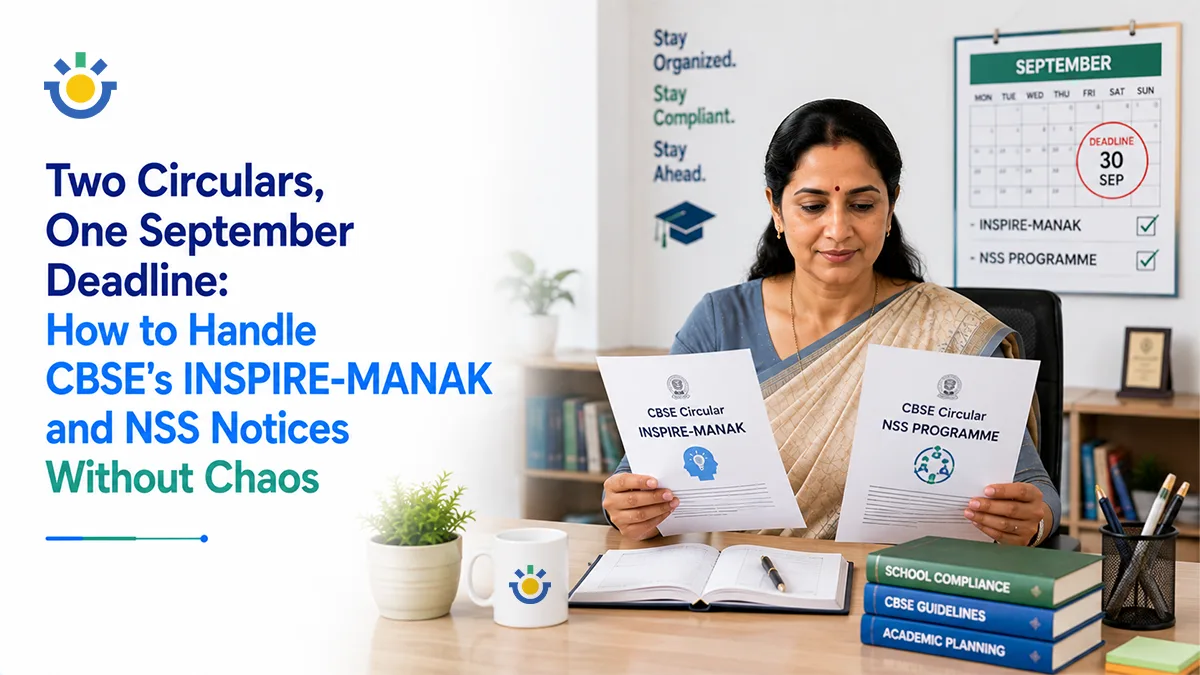
One calls for five breakthrough, original science innovations from your students. The other invites your school to establish and self-fund a formal National Service Scheme (NSS) volunteer unit. Both carry the exact same red deadline: 15 September 2026.
If your immediate reaction was to forward both PDFs to your head of science and sports coordinator with a hasty "Please review and submit by Monday," you aren't alone. Every principal across the board is staring at the same two notices right now.
The stress isn't caused by the work itself. It’s caused by the sudden realization that while your school runs dozens of science fairs and community drives every year, finding documented proof of who did what—and picking the absolute best five without triggering parent complaints—feels like digging through a digital hay barn.
The Direct Answer
CBSE's INSPIRE-MANAK circular requires schools to select and upload up to five original, socially relevant student innovations (Classes VI–XII) via the E-MIAS portal by 15 September 2026. Simultaneously, the NSS Self-Financing Unit notice offers schools an official framework to run volunteer units, requiring internal staffing and budget commitments. Both demands call for an organized, audit-ready student co-curricular record rather than last-minute guesswork.
Quick-Scan Parameter
| Circular Parameter | INSPIRE-MANAK (Acad-52/2026) | NSS Self-Financing Unit (Acad-51/2026) |
| Primary Objective | Nominate original student scientific/tech ideas | Establish a recognized school-level volunteer corps |
| Target Group | Students from Classes VI to XII | Students from Classes XI and XII |
| Quota / Capacity | Maximum 5 nominations per school | Minimum 50 to 100 student volunteers per unit |
| Submission Portal | E-MIAS Portal (inspireawards-dst.gov.in) | MY Bharat / CBSE Submission Gateway |
| Hard Deadline | 15 September 2026 | 15 September 2026 (Initial Phase) |
| Primary Owner | Science HOD / Innovation Coordinator | Sports Director / Social Work In-Charge |
What Landed This Week: INSPIRE-MANAK 2026-27 and MY Bharat NSS
When two major notices arrive back-to-back, it's easy to treat them as routine administrative noise. But looking closely at Circulars 51 and 52 reveals two distinct, high-priority opportunities for your school's official standing.
The CBSE INSPIRE MANAK 2026-27 school nominations release is run jointly by the Department of Science and Technology (DST) and the National Innovation Foundation (NIF). It isn't a typical science project competition where students build cardboard volcanoes. It looks for genuine, original ideas that solve local everyday problems—like an ergonomic tool for local farmers or a smart water-saving valve for school taps.
On the other hand, the CBSE NSS self-financing unit circular details open the door for schools to run an officially sanctioned National Service Scheme unit. Historically reserved for colleges, NSS units in schools offer students official volunteer certification that carries real weight for higher education applications.

INSPIRE-MANAK in Practice: Navigating the E-MIAS Portal
To complete the E-MIAS portal school nomination process, your designated teacher coordinator must log into the portal, update your school profile, and register the top five student ideas.
Each nomination needs four essential pieces of information:
- A clear, title-cased concept name.
- A brief description of the societal problem the idea solves (under 300 words).
- A sketch, diagram, or basic prototype photograph.
- Correct bank account details matching the student's name for direct award transfers.
The practical challenge isn't uploading the data—it's shortlisting the ideas fairly. If your science department didn't record project ideas from the annual exhibition three months ago, teachers end up scrambling through old WhatsApp groups or picking five students at random. That approach risks leaving out quieter, highly innovative students who created remarkable projects earlier in the year.
The NSS Self-Financing Unit: Staffing, Funding, and Logistics
While INSPIRE-MANAK asks for individual student projects, the MY Bharat NSS school unit proposal guidelines ask for institutional commitment.
Setting up a Self-Financing Unit (SFU) means your school funds the unit's regular activities—such as local tree plantation drives, literacy camps, or cleanliness campaigns—without relying on government grants.
Before submitting your proposal, your leadership team needs to answer three concrete operational questions:
- Who is the Programme Officer? You need a dedicated teacher (often a P.E. instructor or social science teacher) willing to complete orientation training and lead weekend community drives.
- Where is the volunteer pool? An NSS unit requires a committed cohort of 50 to 100 students from Classes XI and XII who can log 120 hours of service per year.
- How will activities be verified? You must maintain strict attendance logs, activity photos, and geo-tagged reports for every drive to earn official certification status.
The Big Pattern: CBSE Is Moving from Compliance to Evidence
Notice what is happening here. Board notices are no longer simple "read and acknowledge" memos.
CBSE is systematically moving toward evidence-backed education. Whether it is skill education credits, holistic progress cards, or these latest co-curricular notices, the Board expects schools to nominate, propose, and present concrete proof.

When you attempt to meet these demands using scattered physical files or random spreadsheets, administrative friction builds up fast. You spend ten days gathering basic records and only two days selecting quality entries.
Why This Is Really a Record-Keeping Problem
You cannot nominate the five best science ideas in your school if you never logged the other ninety.
Similarly, you cannot propose an NSS unit if you have no clear history of which senior students consistently show up for community service.
When co-curricular achievements are tracked haphazardly, three friction points consistently emerge:
- Teacher Burnout: Coordinators spend hours re-collecting student account details, project photos, and signatures they already collected twice earlier in the term.
- Selection Bias: Selections default to vocal students who remind teachers of their work, while brilliant projects from quieter students remain unnoticed.
- Audit Anxiety: When board inspectors or district officials request co-curricular participation logs, staff spend days piecing together fragmented records.
By managing circulars and student participation through a connected Calendar & Circulars system, leadership can assign clear internal ownership the exact day a notice arrives.
When your teaching staff logs club activities, science competitions, and volunteer hours into a central Co-Curricular Engine, responding to a board notice takes a few clicks instead of a frantic two-week hunt.
Connecting these co-curricular records directly with your Academic Tracker gives you a complete view of student growth. When it comes time to issue final certificates or compile board portfolios, your team can generate verified, beautifully formatted summaries using a centralized Report Studio.
A Two-Week Action Plan for School Leaders
Here is a simple, structured timeline to handle both circulars before the 15 September deadline:

- Day 1–3: Assign explicit ownership. Formally assign the Science HOD as the owner for INSPIRE-MANAK and the Senior Sports/Social Work teacher for the NSS proposal. Set an internal completion deadline of 5 September.
- Day 4–7: Run an internal idea filter. Ask science teachers across Classes VI–XII to pull project entries from existing term work. Shortlist the top 10 ideas based on novelty and real-world usefulness.
- Day 8–10: Verify details and intake. For INSPIRE-MANAK, confirm that the shortlisted students' names match their bank passbooks exactly to avoid transfer rejections. For NSS, collect initial parent consent forms for a 50-student volunteer cohort.
- Day 11–13: Upload to official portals. Complete the uploads on the E-MIAS portal and submit the MY Bharat NSS proposal through the official portal.
- Day 14: Archive submission receipts. Store submission confirmation PDFs and nominated student entries in your central institutional database for future reference.
Final Thought
Board circulars will continue to land on your desk—often with short deadlines and high expectations. The goal isn't to react to every notice with a fresh wave of administrative panic. By building a clear, continuous record of student achievements throughout the year, you turn frantic late-night rushes into a smooth, routine afternoon workflow.
The Circular Execution Strategy Comparison
| Management Strategy | Traditional Manual Workflow | Centralized Co-Curricular Tracking |
| Data Collection | Paper forms, circular slips, and isolated messaging groups | Continuous digital activity logging throughout the year |
| Idea Selection | Last-minute teacher memory and quick classroom votes | Filterable project database ranked by novelty and impact |
| Verification Overhead | High risk of errors in student names, DOBs, and bank details | Single-source verified student records pulled automatically |
| Preparation Time | 10–14 days of back-and-forth administrative chasing | 2–3 hours of review, shortlisting, and final approval |
| Audit Readiness | Low; records scatter once the deadline passes | High; institutional memory preserved for future years |
Frequently Asked Questions
How many student ideas can a CBSE school nominate for INSPIRE-MANAK 2026-27?
What is the primary deadline for the CBSE INSPIRE-MANAK E-MIAS submissions?
Who is eligible to participate in the INSPIRE-MANAK scheme?
What is required to set up an NSS Self-Financing Unit (SFU) in a school?
Do student ideas submitted for INSPIRE-MANAK require physical working models?
What happens after a student idea is selected at the national level for INSPIRE-MANAK?
Why should a school apply for an NSS Self-Financing Unit if no government grant is attached?
How can school leaders track co-curricular participation without adding workload for teachers?
Stop Chasing Co-Curricular Records Every Time a CBSE Circular Lands
See how Ocoviz centralizes student innovations, activity logs, and board compliance into one quiet, effortless dashboard.
Schedule a 15-Minute Leadership Demo