We Counted Every CBSE Circular a School Had to Act On This Year. The Number Is the Argument.
Key Takeaways
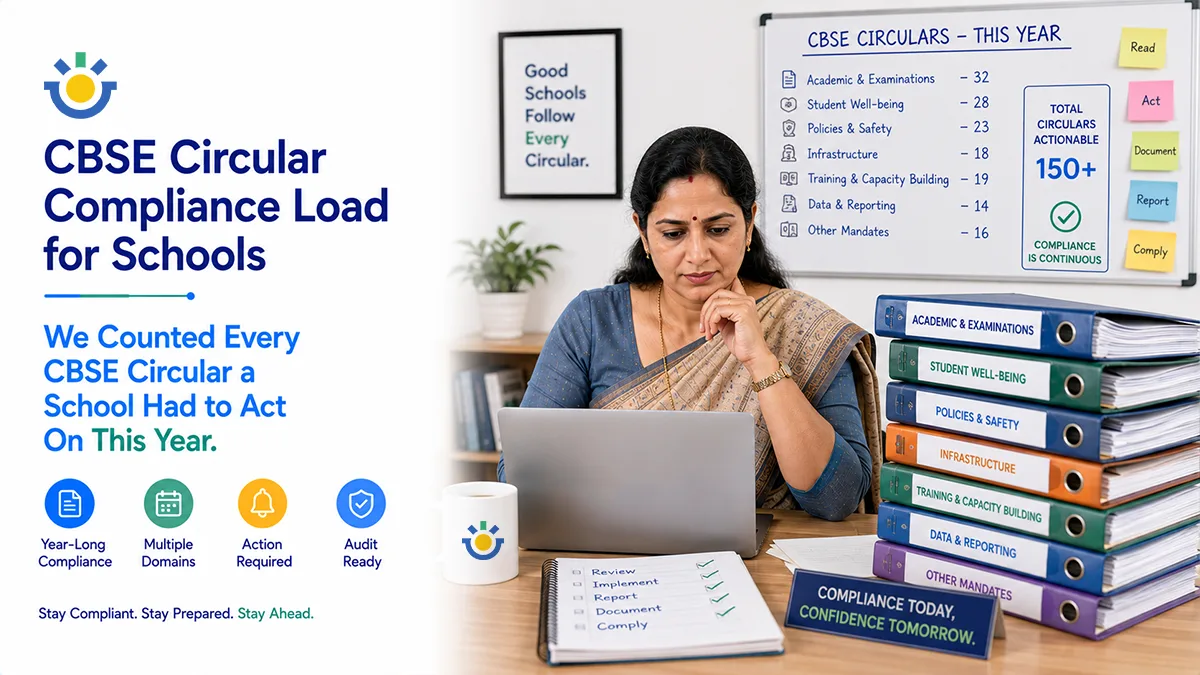
- CBSE issued 214 official communications over a 12-month trailing period, of which 152 (71%) required actionable institutional compliance.
- Principals face an average of 3 actionable board directives every single week, spanning portal uploads, policy changes, and mandatory student nominations.
- Circular distribution is heavily clustered: up to 31 circulars land in a single peak month (July–August), overwhelming standard office workflows.
- Lack of clear departmental ownership leads to compliance risks, fines, lost student opportunities, and potential SARAS affiliation threats.
- Transitioning from an unmanaged email inbox to a dedicated compliance calendar system with automated task mapping is critical for risk mitigation.
Picture this: It’s 4:30 PM on a Thursday in mid-July. Your phone buzzes with a notification from the official CBSE updates group, dropping four separate PDFs into your drive before you’ve even finished your tea.
First comes Circular No. 10/2026 extending the SARAS 7.0 affiliation portal window. Right behind it is the Academic Unit’s update on student nominations for INSPIRE-MANAK, quickly followed by guidelines for setting up National Service Scheme (NSS) Self-Financing Units. Before you can close the app, detailed instructions for implementing the Three-Language Scheme land in your inbox.
Each document carries a different deadline, points to a separate portal, and threatens serious consequences if ignored. None of them arrive with a master checklist or a clear task assignment.
It feels like trying to clear your phone notifications while standing under a open waterfall. You clear three, and five more pop up. But this isn't just everyday work stress—it's a systemic bottleneck that is quietly draining school leaders across the country. To figure out how heavy this burden really is, we stopped guessing and started counting every single circular.
The Direct Answer
Over a 12-month tracking period, CBSE published 214 official communications across its main digital portals. A massive 152 of those circulars (71%) required immediate institutional action, forcing school principals to handle an average of three actionable board directives every single week.
Quick-Scan Parameter
| Compliance Parameter | Annual Count & Operational Metrics |
| Total Tracked Communications | 214 official circulars, notices, and advisories |
| Action-Required Directives | 152 circulars (71% of total board notices) |
| Informational / Advisory Only | 62 circulars (29% of total board notices) |
| Weekly Administrative Pace | ~3 actionable directives arriving every 7 days |
| Peak Clustering Window | July–August (31 circulars landing in a single month) |
| Primary Friction Area | Data entry for OASIS, SARAS, and LOC Portals (31.5%) |
The Counting Method: How We Kept the Data Honest
To make sure these numbers are bulletproof, we set up strict boundary rules before reviewing a single PDF. We tracked official releases across a full 12-month trailing window (August 1 to July 31), monitoring the core board portals: cbse.gov.in, cbseacademic.nic.in, saras.cbse.gov.in, and the CBSE Training Portal.

We included every notice that required a school to actively do something—like gather data, update a portal, adjust classroom timetables, or submit nominations. We excluded basic date sheets, typos corrections, routine exam center updates, and individual affiliation approval letters.
Out of 214 communications, 152 required real work from school staff.
Categorizing the Load: Where Does the Time Actually Go?
When you group those 152 actionable circulars by what they demand from your staff, the structural strain becomes obvious.

Portal Submissions (48 circulars / 31.5%): Data entry for OASIS, LOC candidate uploads, CWSN facility updates, and Health & Physical Education records.
Dated Event Deadlines (38 circulars / 25.0%): Hard cutoffs for SAFAL registrations, Science Exhibitions, and Heritage Quizzes.
Policy & Curriculum Changes (28 circulars / 18.4%): Realignment for the Three-Language Scheme, Skill Education offerings, and section sizes.
Student Nominations (24 circulars / 15.8%): Submission windows for INSPIRE-MANAK, National Teachers Awards, and Veer Gatha entries.
Record Audits (14 circulars / 9.2%): Evidence logs for Kalasetu Art-Integrated projects, safety compliance, and website disclosures.
The Cluster Effect: Why July Feels Like a Tidal Wave
The hardest part of managing CBSE compliance isn't just the total volume—it's the uneven distribution. Circulars don't arrive on a neat, predictable schedule. Instead, they cluster in intense spikes that hit right when schools are busiest.

During the July–August surge, school leaders face an overwhelming 31 circulars in 30 days. Handling that volume while managing the start of a new term creates serious operational friction—and that's when critical details get missed.
Ownership Breakdown: The "Everyone and Nobody" Trap
Ask five people in your school who owns incoming board circulars, and you'll immediately see why things fall through the cracks. The school inbox has no clear, single owner.

Because circulars cover everything from IT to sports, schools usually rely on manual email forwards. But when a notice passes through four different hands without a clear owner or tracking tool, responsibility dissolves completely.
The Real Cost of a Missed Circular
Missing a circular isn't just an administrative oversight—it carries real operational consequences:
- Lost Opportunities for Students: Missing submission windows for schemes like INSPIRE-MANAK or national sports trials quietly deprives talented students of big achievements for their portfolios.
- Financial Fines and System Lockouts: Late LOC (List of Candidates) or OASIS uploads bring daily cash fines and can even delay student admit cards.
- Affiliation Risks: Ignoring mandatory updates on section strengths, safety logs, or public disclosures can trigger formal show-cause notices during SARAS affiliation reviews.
Why Standard Inboxes Fail at Compliance
Traditional email inboxes were built for basic messaging, not for managing complex compliance workflows. An inbox can't turn a multi-page PDF into an assigned task, track deadlines across different departments, or verify that an upload actually happened.

Managing compliance effectively requires an active workflow system. By using a centralized platform like Calendar & Circulars, school leaders can instantly turn incoming board circulars into assigned tasks with clear deadlines.
For institutions running multiple schools, maintaining group-wide compliance across campuses becomes effortless with Multi-Campus Analytics.
Integrating these tracking workflows with key insights from our State of School Intelligence in India 2026 report and publishing verified documentation through Report Studio helps institutions earn recognition like the Ocoviz Smart School Badge.
Using intelligent tools like Ocoviz, schools can finally move away from reactive inbox management and take full control of their administrative compliance.
A Practical Compliance Action Plan for Leadership
- Designate a daily compliance owner: Assign one administrative staff member to check official board portals every morning at 10:00 AM rather than relying on random chat groups.
- Categorize incoming circulars immediately: As soon as a notice arrives, tag it under one of five operational areas: Portal, Event Deadline, Policy, Nomination, or Audit.
- Assign a single owner with an internal deadline: Send the circular to one specific department head, setting an internal completion date three days ahead of CBSE's official deadline.
- Maintain a digital proof vault: Store portal receipts, confirmation screenshots, and official submission records in a central, searchable digital folder.
- Run a weekly multi-campus review: Group leadership should run a quick 10-minute weekly audit to check completion statuses across all branches and resolve delays early.
Final Thought
The heavy flow of CBSE circulars isn't going to slow down. But while you can't control how many notices the board issues, you can control how your school handles them. By replacing messy email chains with a clear, organized tracking system, you can protect your staff from burnout and make sure your school never misses an important deadline again.
Compliance Management: Email Inboxes vs. Automated Systems
| Management Metric | Manual Email Inbox Setup | Automated Compliance Engine |
| Notice Ingestion | Manual checking across multiple web portals | Automatic aggregation of official board feeds |
| Task Delegation | Forwarded emails without tracking or accountability | Role-based task assignments with clear completion dates |
| Deadline Tracking | Scattered reminders on personal calendars | Live dashboard displaying active compliance deadlines |
| Multi-Campus Visibility | Phone calls and manual updates from individual branches | Real-time multi-campus analytics showing branch progress |
| Audit Preparation | Searching through old email threads and paper files | Centralized digital archive containing verified receipts |
Frequently Asked Questions
How many official circulars does CBSE release every academic year?
What month sees the highest concentration of CBSE circulars?
What are the risks of missing a mandatory CBSE circular deadline?
How can school leaders manage the high volume of CBSE circulars without burning out staff?
Why do standard email inboxes fail at managing school compliance?
How do group schools track CBSE compliance across multiple campuses?
Ready to Stop Fighting the CBSE Circular Waterfall?
Discover how Ocoviz converts messy board PDFs into assigned tasks, clear deadlines, and audit-ready compliance records.
Request a Compliance Automation Demo