Below 75%? How CBSE Attendance Condonation Works Under Rule 14—and the Deadline Most Parents Miss
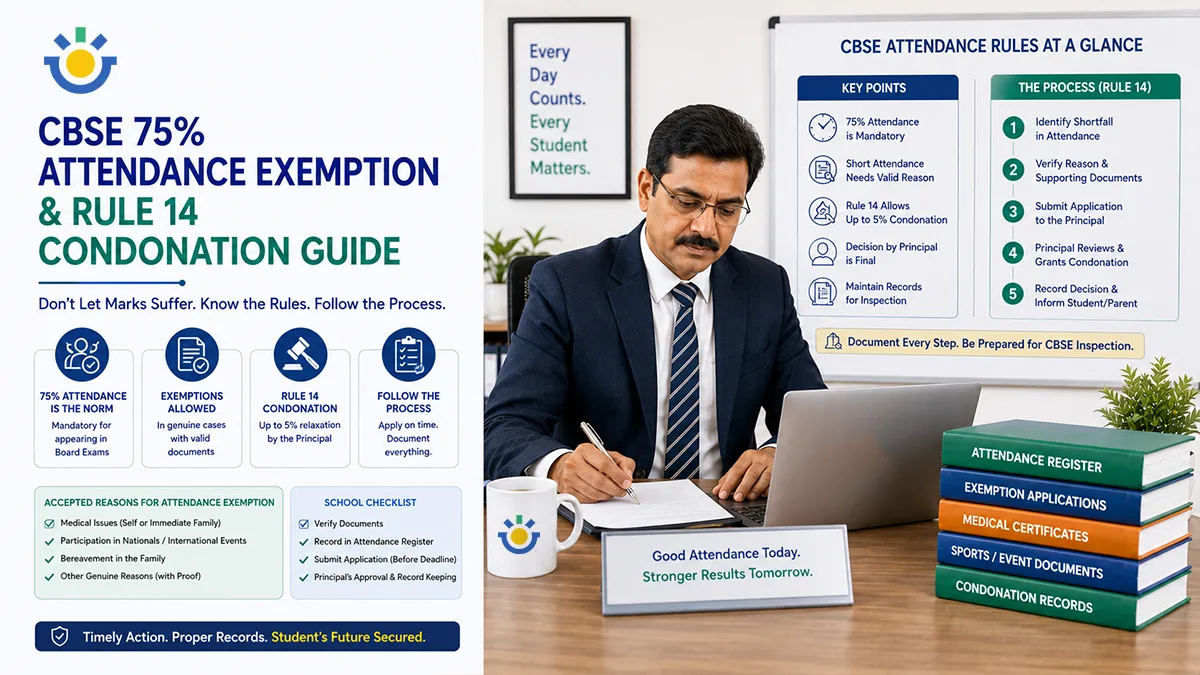
Key Takeaways
- CBSE Rule 13 mandates a strict 75% minimum attendance threshold for Class 10 and 12 board exam eligibility.
- Rule 14 allows attendance condonation of up to 15% (bringing the minimum requirement to 60%) exclusively for documented medical emergencies, loss of a parent, or authorized national sports participation.
- Attendance is calculated up to January 1, and schools must submit the official shortage list to CBSE by January 7.
- Medical exemptions require certificates signed by a Government Doctor along with hospital admission records and test reports; generic private clinic notes are summarily rejected.
- Once the school submits the final shortage list to the Regional Office, no late documentation or retrofitted leave applications are accepted.
It usually happens on a random Tuesday in November. Your teenager comes home, tosses their backpack onto the sofa, and offhandedly mentions that their class teacher called them to the desk during period three. The message? Their attendance is sitting at 68%, and if it doesn't cross 75% by winter break, they might not get their board exam admit card.
Panic sets in. You remember the two weeks they missed when dengue hit in September, plus that four-day family event in August. You figure a quick handwritten note or a prescription from your family doctor will clear things up before exams start in February.
In reality, the board exam gatekeeping process does not work on informal requests. CBSE has tightened attendance auditing through surprise school inspections and strict digital logging. If your child falls behind the line, your option isn't an informal chat with the principal—it is a formal, document-heavy legal process under Rule 14.
The Direct Answer
CBSE Rule 13 mandates a 75% minimum attendance requirement for Class 10 and 12 board exams, while Rule 14 empowers the Board to condone a shortage of up to 15% under specific, verified emergencies. To receive approval, schools must submit verified paperwork—including certificates from a Government Doctor—to the CBSE Regional Office before January 7.
Quick-Scan Parameter
| CBSE Attendance Parameter | Rule 13 (Standard Mandate) | Rule 14 (Condonation Allowance) |
| Minimum Percentage | 75% mandatory attendance | Condonation up to 15% (down to 60% total) |
| Attendance Counting Cutoff | January 1 of the exam year | January 1 of the exam year |
| Submission Deadline to CBSE | January 7 (hard cutoff) | January 7 (hard cutoff) |
| Valid Grounds | Regular classroom presence | Prolonged illness, parent bereavement, national sports |
| Mandatory Proof | Daily school register / digital log | Govt doctor certificate, discharge summaries, SAI letters |
The Rule in One Paragraph: Rule 13 vs. Rule 14
Think of Rule 13 as the baseline boundary line: every regular student registered for the CBSE Class 10 or 12 board exams must attend at least 75% of total working days from the start of the session up to January 1.
Rule 14 is the escape hatch, but it is narrow. It gives the Chairman of CBSE the specific legal authority to condone an attendance shortage of up to 15%. That means if a student's attendance drops between 60% and 74.9%, Rule 14 can bridge the gap—provided the absence falls under recognized emergency categories and is backed by official evidence.

What Actually Counts as Ground for Condonation (and What Does Not)
CBSE circulars leave little room for subjective interpretation. The board categorizes valid reasons clearly, and routine personal reasons are ruled out immediately.

- Prolonged Illness: Severe conditions like typhoid, dengue, fractures, or surgical recovery requiring extended rest.
- Family Tragedy: The death of a parent or primary caregiver.
- National Sports: Participation in events organized by the Sports Authority of India (SAI) or the School Games Federation of India (SGFI).
- What fails instantly: Taking time off for private coaching institutes, attending out-station family weddings, or taking undocumented rest days before unit tests.
Documentation: What Gets Approved vs. What Gets Rejected
The biggest trap for parents is assuming that any signed letter from a neighborhood clinic will satisfy the board. CBSE’s standard operating procedure requires a clear, verifiable chain of custody for every missed day.

- The Gold Standard: A medical certificate issued by a Government Doctor, complete with registration numbers, official stamps, matching lab reports, blood test results, or hospital discharge summaries covering the exact dates of absence.
- The Common Rejection: A single-page, hand-written note from a private general practitioner issued two months after the child recovered, lacking test reports or corresponding leave applications filed at the time of illness.
The Date That Matters Most: The January 1 Cutoff
Most parents assume they have until the first day of board exams in mid-February to pull their child’s attendance percentage up. This assumption is incorrect.

The board calculates eligibility based on working days held from the start of the academic session up to January 1. Attending 100% of classes in January will not alter the official percentage sent to CBSE because the calculation window has already closed.
The Finality of the Shortage List
Under CBSE guidelines, schools must compile and submit their official list of attendance shortage cases to the Regional Office by January 7.
Once this electronic list is signed and transmitted, the portal locks. Schools cannot alter attendance figures, retroactively insert medical leaves, or attach newly acquired certificates after January 7. If a student's name is submitted as un-condoned due to missing documents, CBSE's system automatically marks them ineligible to receive an admit card.
What Your School Was Obliged to Tell You early on
CBSE places explicit responsibilities on school administration regarding attendance tracking. Schools are required to:
- Issue written attendance warnings to parents as soon as a student drops below 75% at term checkpoints.
- Maintain daily physical or digital attendance registers ready for surprise CBSE inspection teams.
- Reject informal verbal leave requests and enforce written leave applications within 48 hours of an absence.
Schools using modern administration systems like Ocoviz automate this process.
Through real-time tracking modules such as Smart Attendance, schools monitor daily logs without manual errors.
Parents receive instant updates via Parent Connect, while administrators track upcoming CBSE deadlines using Calendar & Circulars and flag struggling students early via Risk Radar.
What to Do This Week If Your Child Is Tracking Below 75%
- Calculate the Exact Percentage: Ask the school office for the official count of total working days and your child’s attended days up to this week.
- Audit Past Absences: Cross-reference every absent day against your family records to isolate genuine medical or sports-related absences.
- Secure Government Medical Validation: If past medical absences were treated by a private physician, consult a certified Government Doctor to validate the diagnosis and records as required by CBSE guidelines.
- Compile the Complete Dossier: Gather the initial written leave application, prescription copies, lab test results, and discharge summaries into a single file.
- Submit a Formal Representation: Hand-deliver the complete dossier with a formal cover letter to the school principal before winter break begins.
Questions to Ask the School Office (In Order)
- "What is my child's official attendance percentage as logged in the school's CBSE register today?"
- "How many total working days is the school projecting between now and the January 1 cutoff date?"
- "Which specific absence dates currently lack formal written leave applications or medical proof in your records?"
- "Does the school require our medical documents to be re-verified by a Civil Surgeon or Government Hospital authority?"
- "On what exact date will the school submit the final Rule 14 shortage list to the CBSE Regional Office?"
Actionable Steps for Parents & School Leaders
- Audit attendance monthly: Track working days at the end of every month rather than waiting until November.
- Submit medical leave immediately: Deliver written medical notices and prescriptions to the school within 48 hours of your child falling ill.
- Obtain government doctor endorsements: Ensure extended medical leave over 5 days is certified by a registered Government Medical Officer.
- Keep physical copies of sports authorizations: Retain official invitation letters and attendance certificates issued by SAI or SGFI.
- Verify paperwork before December 15: Review all submitted documents with the school administrative office well before the January 1 calculation window closes.
Final Thought
The 75% attendance rule is not designed to penalize students who face genuine health or personal crises. It exists to ensure academic consistency throughout the year. By understanding how Rule 14 works, acting early, and maintaining verified paperwork, parents can resolve attendance shortages well before the January deadline—keeping their child's focus where it belongs: on preparing for their exams.
Strategy Comparison: Approved vs. Unapproved Condonation Documentation
| Document Parameter | CBSE Standard Compliant (Approved) | Non-Compliant Submission (Rejected) |
| Medical Authority | Certificate signed by a registered Government Doctor | Handwritten note from an unverified private clinic |
| Diagnostic Evidence | Accompanied by official lab reports, X-rays, or hospital slips | Prescription slip with no supporting diagnostic tests |
| Submission Timing | Filed at the time of illness or before the January 1 cutoff | Retroactively submitted after the January 7 list lock |
| Sports Leave Proof | Official delegation letters from SAI / SGFI / recognized bodies | Informal permission letters from local sports clubs |
| School Endorsement | Formal principal recommendation letter in prescribed CBSE format | Plain letter without official register entries or proforma |
Frequently Asked Questions
Can a student write CBSE board exams with less than 75% attendance?
What medical certificates are accepted for CBSE attendance shortage exemption?
When is the final deadline to calculate CBSE attendance shortage for Class 10 and 12?
Can private coaching or competitive exam prep justify an attendance shortage?
What happens if a school fails to submit an attendance condonation case before January 7?
Can attendance shortage below 60% be condoned by CBSE?
Eliminate Attendance Compliance Surprises Before the January Cutoff
Discover how Ocoviz automates CBSE Rule 13/14 compliance, real-time attendance tracking, and parent notifications.
Explore Smart Attendance Controls