Proving 50 CPD Hours: The Teacher Training Record CBSE Actually Asks to See
Key Takeaways
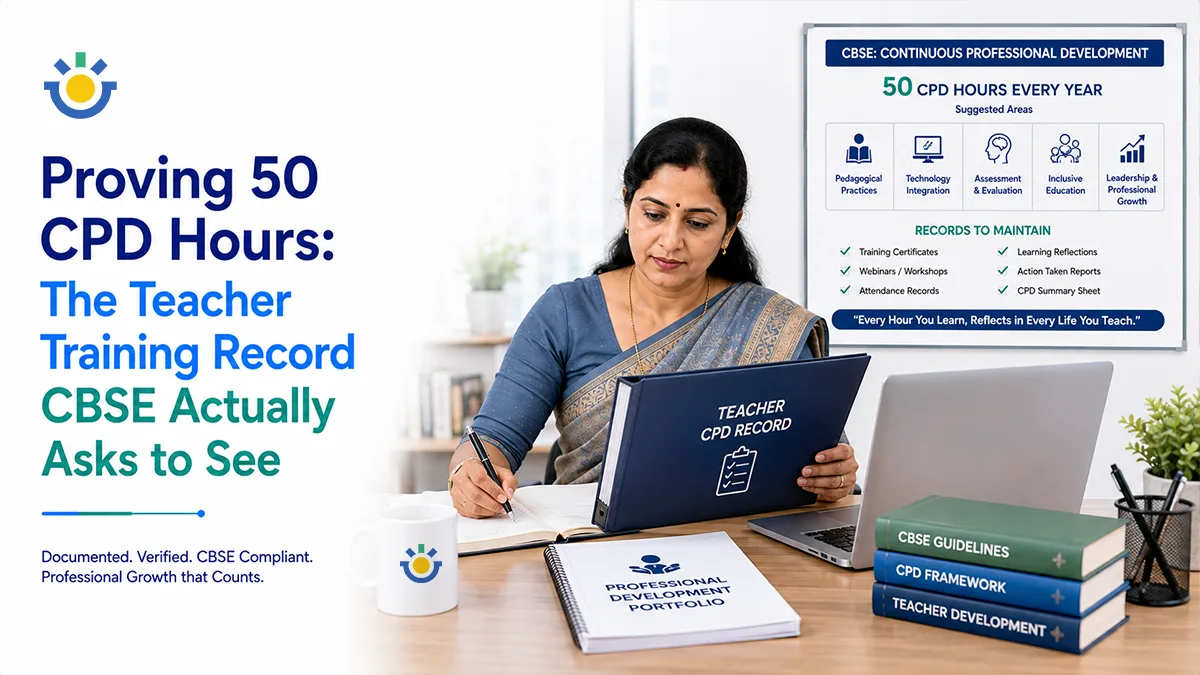
- CBSE mandates 50 hours of Continuous Professional Development (CPD) per teacher per year, strictly split into 25 hours via CBSE/Government training portals and 25 hours via in-house or school-complex sessions.
- Training hours must align with three NPST domains: Core Values and Ethics (12 hrs), Knowledge and Practice (24 hrs), and Professional Growth and Development (14 hrs).
- Board duties, item development, practical external examinations, and classroom research can be counted toward the in-house/developmental quota up to an 11-hour ceiling.
- CBSE-organized training must be registered via the CBSE Training Portal, while school-conducted training records must be updated directly on the OASIS portal.
- Failure to produce verified per-teacher evidence files during inspections risks penalties under Clause 12.2.9 of the CBSE Affiliation Bye-laws.
It is a Tuesday morning in early November. An affiliation inspection committee walks into the principal's office for a routine compliance review. They bypass the physical infrastructure folders, sit at the conference table, and ask for a single binder: "Please show us the verified CPD logs and domain mapping for your senior secondary science department."
The room goes quiet. The school did send teachers to workshops throughout the term. The science department attended a three-day pedagogy seminar in July, and the computer teacher completed online modules on weekends.
However, the records exist only as scattered WhatsApp PDF downloads, lost email attachments, and unverified participation receipts. Nobody mapped those workshops against NPST standards, nor entered the in-house hours into the OASIS portal.
This scenario plays out in hundreds of schools every year. The primary challenge isn't completing the 50 hours of professional development—it's proving that those hours meet CBSE's specific structural criteria when inspectors review your records.
The Direct Answer
Under CBSE notification TRG-02/2025 (referencing Affiliation Notification 16/2021), every teacher and principal must complete 50 CPD hours per academic year. This requirement is divided into 25 hours through CBSE/Government portals and 25 hours through school-level in-house training. Schools must log external sessions on the CBSE Training Portal, update in-house hours on the OASIS portal, and maintain an audit-ready physical or digital evidence folder for every teacher.
Quick-Scan Parameter
| CPD Component | Hour Requirement | Execution Platform | Documentation Needed |
| Board / External Training | 25 Hours Minimum | CBSE Training Portal | Official CBSE digital completion certificates |
| In-House / School Training | 25 Hours Maximum | School Record + OASIS Upload | Attendance sheets, deck slides, session outcomes |
| Core Values & Ethics Domain | 12 Hours Target | Combined (Board & School) | Session mapping aligned with NPST Standards |
| Knowledge & Practice Domain | 24 Hours Target | Combined (Subject-Specific) | Subject pedagogy workshop logs & resources |
| Professional Growth Domain | 14 Hours Target | Combined / Recognized Tasks | Published articles, exam duties, research logs |
The Mandate Architecture: The 25 + 25 Split
Understanding CBSE 50 hours CPD record keeping begins with the fundamental split mandated by the Board:

A common compliance error is completing all 50 hours through internal school meetings or external commercial webinars. CBSE explicitly requires at least 25 hours to be conducted directly by CBSE Centre of Excellence (COE), NCERT, or recognized government bodies. The remaining 25 hours can be organized internally or through local Hubs of Learning.
The Domain Split Most Schools Miss
Completing 50 random training hours is not enough. CBSE aligns professional development with the National Professional Standards for Teachers (NPST), requiring training hours to be distributed across three mandatory domains:
1. Core Values and Ethics (12 Hours)
Focuses on child safety, inclusive education, professional code of conduct, gender sensitivity, and NEP alignment.
- Board Allocation: 6 Hours
- In-House Allocation: 6 Hours
2. Knowledge and Practice (24 Hours)
Focuses on subject-specific pedagogy, competency-based assessment design, classroom management, and technology integration.
- Board Allocation: 16 Hours (minimum 12 hours offline subject-specific)
- In-House Allocation: 8 Hours
3. Professional Growth and Development (14 Hours)
Focuses on action research, peer mentoring, educational leadership, and resource creation.
- Board Allocation: 3 Hours
- In-House Allocation: 11 Hours

What Counts: The Academic Activity Quantum Table
To relieve teacher workload, CBSE allows specific academic and operational contributions to count toward the 11-hour in-house quota for Domain 3 (Professional Growth). However, these tasks carry strict hour caps:
| Recognized Academic Activity | Awarded Quantum | Verification Document Required |
| Board Exam Evaluation Duty (Full assignment as Examiner / AHE / HE) | 6 Hours | Official relieving certificate from Regional Office |
| Question Bank / SQP / Item Development for CBSE | 3 Hours | CBSE appointment letter / acknowledgment memo |
| Practical External Examiner Duty (Appointed by CBSE) | 3 Hours | School appointment copy & duty completion slip |
| Action Research / Classroom Research Project | 2 Hours | Written research report with baseline & endline data |
| Mentoring Fellow Teachers / Writing Reflective Journals | 2 Hours | Peer observation log / published reflective entry |
| Technical Integration / E-Content Creation | 2 Hours | Link to published resource / LMS deployment log |
The Ceiling Clause
Schools cannot stack these activities endlessly. The maximum combined credit allowed from developmental and academic activities is capped at 11 hours per teacher per year under the in-house allocation for Domain 3. The remaining 39 hours must come from structured workshops and training sessions.
Dual Recording Portals: CBSE Training Portal vs. OASIS
A major source of confusion in teacher training compliance CBSE affiliation is understanding where specific data must be recorded. CBSE uses two separate digital systems:

- The CBSE Training Portal: Used to register teachers for official COE workshops (online or offline). Certificates generated here update automatically on CBSE's backend.
- The OASIS Portal: Used by school administrators to log in-house training sessions, Hub of Learning workshops, and approved academic contribution credits.
Failing to update in-house hours on OASIS leaves your school's official compliance profile incomplete, even if internal training sessions were conducted successfully.
The Inspection Evidence File: What Inspectors Expect
During an affiliation review or surprise audit, inspectors look for physical proof backing up the numbers on OASIS. Every school should maintain a master CPD Compliance File containing a dedicated section for each teacher:
- Section A: Summary Sheet. A single page listing total hours completed, split by 25 external / 25 internal, and categorized across the three NPST domains.
- Section B: Board Certificates. Original or verified digital certificates downloaded from the CBSE Training Portal.
- Section C: In-House Evidence. Attendance sheets signed by the teacher, session presentation slides, and a brief 100-word reflection on classroom application.
- Section D: Activity Proofs. Official duty letters for board evaluations, practical exam assignments, or published action research papers.
Managing training schedules, assigning internal workshops, and generating audit-ready summary sheets becomes straightforward when integrated into a central platform like Calendar & Circulars.
By syncing teacher duty allocations across your Academic Tracker, leadership maintains complete visibility over academic workloads. For multi-campus networks, keeping track of staff development benchmarks across branches is simplified using Multi-Campus Analytics.
When inspection teams ask for individual training profiles, administrators can compile verified, domain-mapped compliance dossiers instantly using Report Studio, helping earn recognition through initiatives like the Ocoviz Smart School Badge.
Penalty Provisions Stated Plainly
Failure to comply with CPD requirements is treated as a structural compliance breach rather than a minor clerical error.
Under Clause 12.2.9 of the CBSE Affiliation Bye-laws, the Board maintains explicit authority to issue formal show-cause notices, impose financial penalties, or downgrade affiliation status for schools that fail to ensure staff participation in mandatory training programs.
Furthermore, CBSE circulars explicitly state that training duties assigned by the Board are deemed official duty. Schools are prohibited from deducting leave or salary for teachers attending mandatory board training sessions.
The Month-by-Month Execution Plan
To avoid a desperate rush in February, follow this balanced distribution plan across the academic calendar:

- April–May: Register all teaching staff on the CBSE Training Portal. Map existing qualifications and schedule the first block of 12 external COE hours focusing on Core Values and Subject Pedagogy.
- June–August: Run internal summer training sessions. Complete 10 hours of in-house workshops on competency-based assessments and classroom management. Log attendance immediately.
- September–November: Complete the remaining 13 external training hours. Collect official duty certificates for teachers participating in board evaluation or practical exam duties.
- December–January: Finalize the remaining 15 in-house hours. Compile credits from action research projects, e-content creation, and internal peer mentoring.
- February–March: Perform an internal compliance audit. Ensure every teacher's training log meets the 50-hour threshold, matches the domain distribution rules, and is fully uploaded to the OASIS portal.
Final Thought
Teacher training should elevate classroom instruction, not generate administrative stress. By setting up a clear tracking system at the beginning of the year, school leaders can ensure their staff receives meaningful professional development while maintaining complete, audit-ready compliance records.
Compliance Comparison: Unstructured vs. Audit-Ready
| Record-Keeping Metric | Unstructured School Setup | Audit-Ready Compliance Setup |
| External Hour Tracking | Physical paper certificates in loose staff files | Digital repository mapped by teacher, date, and COE ID |
| In-House Training Logs | Informal meeting notes without domain tagging | Attendance logs mapped to NPST domains |
| Board Duty Credits | Unclaimed or improperly calculated training hours | Activity quantum capped correctly at 11 hours maximum |
| Portal Upload Status | Delayed, end-of-year rush on OASIS | Rolling monthly updates on the OASIS portal |
| Inspection Readiness | Days of manual paper hunting during audits | 1-click generation of verified individual compliance files |
Frequently Asked Questions
Can a teacher complete all 50 mandatory CPD hours through online courses?
How are the 50 mandatory CPD hours split between external and internal training?
What is the mandatory domain distribution for CBSE CPD hours?
Do board examination evaluation duties count toward a teacher's 50-hour requirement?
What is the maximum number of hours a teacher can claim from non-workshop academic tasks?
Where must in-house teacher training hours be officially recorded?
Can excess CPD hours completed in one academic year be carried over to the next?
What penalty can CBSE impose on schools that fail to meet CPD training mandates?
Eliminate the February Rush on CBSE CPD Hours
See how Ocoviz tracks domain splits, automates evidence collection, and generates audit-ready OASIS summaries.
Schedule a Compliance Management Demo